Introduction
Uncontrolled resource provisioning frequently drives enterprise cloud expenditure past projected financial baselines. Although elastic cloud environments provide remarkable developer agility, decentralized infrastructure creation routinely triggers severe budget volatility across engineering units. Therefore, modern digital enterprises actively adopt structured governance frameworks to regain complete control over operational spending.
Enrolling in dedicated FinOps Training equips software architects, DevOps leads, and financial controllers with actionable cloud cost accountability. When cross-functional departments collaborate through shared operational telemetry, they translate raw utilization data into high-return business assets. Developing these practical capabilities guarantees that your technical deployments actively protect gross margins while accelerating product innovation.
Why FinOps Has Become Essential for Modern Cloud Environments
Traditional on-premises data centers operated under predictable capital expenditure models where procurement teams evaluated hardware acquisitions through structured approval cycles. Conversely, modern hyperscale platforms introduce dynamic operational expenditures where any developer can deploy compute clusters within seconds. Because resource consumption happens continuously in production, retrospective invoice reconciliations completely fail to stop runaway expenses.
Adopting continuous financial discipline bridges this operational gap by integrating fiscal accountability directly into everyday development workflows. Instead of treating cost reduction as an arbitrary constraint, this collaborative model optimizes unit economics, infrastructure efficiency, and delivery speed. Consequently, technology organizations scale resilient digital systems while maintaining comprehensive transparency over their multi-cloud investments.
Common Cloud Cost Challenges Faced by Organizations
Most enterprises face persistent resource waste due to unmonitored infrastructure, orphaned volumes, and disconnected departmental communication. Software developers often over-allocate memory and compute instances to guarantee high availability, generating massive idle capacity. Furthermore, multi-cloud architectures produce fragmented billing streams that leave financial managers without actionable insight.
| Operational Bottleneck | Root Technical Cause | Enterprise Financial Impact |
| Opaque Invoicing | Inconsistent metadata tagging strategies | Unclear departmental cost attribution |
| Compute Waste | Over-provisioned virtual machine instances | Uncontrolled monthly spending spikes |
| Commitment Gaps | Uncoordinated discount contract purchases | Substantial forfeiture of provider savings |
Without continuous governance guardrails, these hidden operational inefficiencies quietly erode profitability across the organization.
What Is FinOpsSchool
FinOpsSchool delivers a hands-on, career-focused learning environment designed to connect modern cloud systems engineering with rigorous financial governance. The platform eliminates abstract lectures by immersing participants in production-grade multi-cloud billing datasets, enterprise cost-allocation pipelines, and automated remediation engines.
Additionally, the curriculum covers AWS, Microsoft Azure, and Google Cloud platforms to establish versatile, vendor-agnostic proficiency. Through live scenario analysis, practitioners master cost allocation, rightsizing workflows, commitment modeling, and automated anomaly remediation. This comprehensive approach empowers infrastructure engineers, finance managers, and technology directors to drive immediate, measurable financial efficiency within their organizations.
Understanding the Fundamentals of FinOps Training
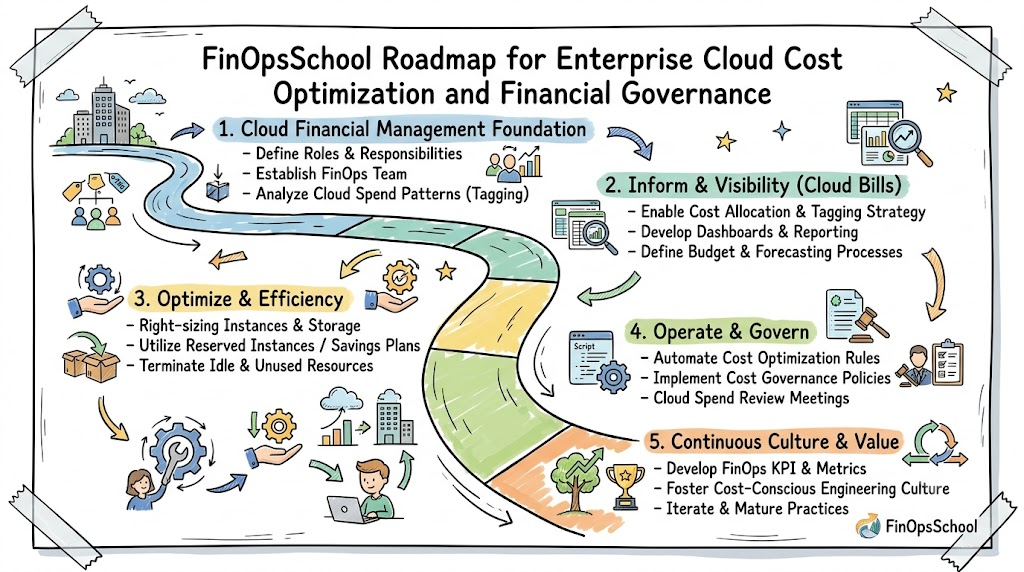
A structured educational program grounds practitioners in the three core phases of cloud financial governance: Inform, Optimize, and Operate. During the Inform phase, teams gain high-resolution cost visibility through standardized tagging hierarchies and normalized billing feeds. Next, the Optimize phase identifies waste-reduction opportunities, downscales underutilized workloads, and purchases discounted commitment tiers.
Pursuing specialized Cloud Cost Optimization Training empowers engineers to evaluate architectural tradeoffs objectively. Developers instantly understand how microservice adjustments alter gross margins in production. Consequently, development teams shift away from emergency cost-cutting campaigns toward continuous, proactive infrastructure planning.
Why FinOps Certification Is Becoming More Important
Enterprises expanding their multi-cloud footprints actively recruit certified practitioners who can optimize infrastructure investments without degrading system performance. Obtaining an industry-standard FinOps Certification validates your ability to lead cross-departmental cost initiatives, oversee complex operational budgets, and build automated governance frameworks.
Moreover, holding this credential elevates your professional standing in a competitive technology talent market. Executive leaders prioritize certified specialists who know how to protect financial margins while supporting rapid software releases. Achieving formal validation proves that you possess the specialized business acumen and technical expertise required to safeguard organizational profitability.
What You Learn in a Comprehensive FinOps Course
A complete educational path provides the actionable blueprints necessary to govern complex cloud estates effectively. Students analyze normalized billing streams, configure departmental chargeback systems, and monitor unit economics across diverse application portfolios.
Enrolling in an advanced FinOps Course ensures you master:
- Standardizing multi-cloud billing feeds into unified real-time executive dashboards.
- Implementing comprehensive metadata tagging standards for granular cost attribution.
- Deploying automated threshold notifications and anomaly remediation scripts.
- Building clear showback and chargeback systems that foster team-level accountability.
Understanding Cloud Financial Management Principles
Successful cloud financial governance demands open data transparency and continuous collaboration between engineering, procurement, and finance units. When every stakeholder evaluates the exact same operational telemetry, teams make balanced compromises between infrastructure velocity, system reliability, and overall hosting expense.
Moreover, leading enterprises benchmark infrastructure spending against tangible business drivers, such as hosting cost per active subscriber. Central governance teams establish baseline organizational policies, while individual product pods maintain direct responsibility for their resource usage. This distributed model maintains strict budget discipline without creating operational bottlenecks for developer teams.
Building Strong Cloud Cost Visibility and Governance
Total operational transparency forms the foundation of every lasting cost optimization program. Organizations build comprehensive visibility by enforcing mandatory metadata tagging rules across all cloud subscriptions, container clusters, and serverless applications. Automated compliance scanners immediately isolate non-compliant resources to maintain data cleanliness.
Through rigorous FinOps Certification Training, practitioners learn to build dynamic visualization tools and real-time operational notifications. Consequently, finance directors establish reliable expenditure forecasts, while technical leads catch unexpected resource spikes before invoices arrive. Consistent visibility converts raw usage data into decisive organizational intelligence.
Cost Allocation, Budgeting, and Forecasting Explained
Accurate cost allocation links cloud infrastructure spending directly to the development teams, corporate divisions, or business products consuming those assets. Organizations frequently use showback reporting to build internal awareness, whereas chargeback mechanisms directly debit business unit budgets for exact infrastructure utilization.
Additionally, elastic cloud environments demand rolling, dynamic forecasting models instead of rigid static budgets. By combining historical telemetry patterns with planned feature launches, managers generate highly accurate spending projections. This proactive feedback loop guarantees that teams accommodate upcoming capacity demands without triggering unexpected financial deficits.
Optimizing AWS, Azure, and Google Cloud Spending
Every major hyperscale provider offers distinct compute families, storage options, and volume discount plans that alter operational costs. Optimizing AWS, Microsoft Azure, and Google Cloud environments requires deep technical comprehension of workload demand, data transfer pathways, and storage tiers.
| Cloud Ecosystem | Key Technical Lever | Native Governance Solution |
| AWS | Graviton processors, S3 Intelligent-Tiering | AWS Cost Explorer, Compute Optimizer |
| Microsoft Azure | Azure Hybrid Benefit, archive storage tiers | Azure Cost Management, Advisor |
| Google Cloud | Custom machine sizing, sustained use discounts | Cloud Billing, Recommender |
Applying these vendor-specific mechanisms eliminates costly idle capacity while preserving exceptional application performance and availability.
Understanding Reserved Instances, Savings Plans, and Rightsizing
Compute infrastructure routinely consumes the greatest portion of cloud expenditure, making workload rightsizing a fundamental engineering requirement. Practitioners continuously analyze historical CPU, memory, and network throughput to adjust over-provisioned virtual machines to their optimal tiers.
After establishing a lean baseline workload, organizations secure deep pricing discounts using structured commitments:
- Savings Plans & Committed Use Contracts: Deliver flexible hourly rate discounts across diverse compute families and geographic regions.
- Reserved Instances: Secure substantial cost reductions for predictable, steady-state database clusters and monolithic systems.
- Continuous Rightsizing: Guarantees that multi-year discount contracts cover lean, efficient architectures rather than idle computing capacity.
FinOps Practitioner Training for Career Growth
Business unit heads, financial controllers, and procurement specialists increasingly oversee cloud-centric product teams. Completing practical FinOps Practitioner Training equips non-technical leaders with the core operational vocabulary and analytical frameworks needed to collaborate with systems engineers.
As a result, practitioners successfully interpret complex cloud billing records, negotiate enterprise vendor contracts, and define unit economic models. Gaining these interdisciplinary capabilities substantially boosts your executive career trajectory. Because enterprises continue expanding digital investments, professionals who bridge finance and software engineering command exceptional industry value.
FinOps Engineer Training for Technical Professionals
DevOps specialists, cloud architects, and site reliability engineers manage infrastructure directly at the deployment layer. Taking targeted FinOps Engineer Training empowers technical teams to weave cost governance policies straight into continuous delivery pipelines.
Technical professionals master vital infrastructure automation tactics, including:
- Writing Infrastructure as Code governance guardrails using Terraform and CloudFormation.
- Optimizing Kubernetes pod resource bounds, container requests, and cluster bin-packing.
- Fine-tuning serverless execution timeouts, concurrency limits, and memory provisioning.
- Implementing automated deployment gates that block cost-inefficient architectural configurations.
Benefits of Corporate FinOps Training for Enterprise Teams
Driving permanent cloud financial efficiency across an enterprise requires a shared operational culture rather than isolated individual actions. Investing in customized Corporate FinOps Training aligns technical, financial, and management teams around standardized governance principles and shared performance metrics.
Furthermore, tailored corporate programs help organizations establish dedicated Centers of Excellence. Teams work directly on their active infrastructure setups, billing reports, and internal workflows during practical training workshops. This direct engagement exposes hidden cloud waste and builds durable financial governance across all business lines.
Advantages of FinOps Online Training for Modern Professionals
Balancing demanding enterprise delivery schedules with continuous professional education requires dynamic, flexible training options. Choosing FinOps Online Training provides remote practitioners with round-the-clock access to interactive sandbox environments, self-paced modules, and practical case studies.
Moreover, virtual platforms connect learners with an active global network of cloud specialists and financial managers. Interactive discussion groups and practical group challenges allow practitioners to solve complex real-world billing puzzles together. This modern educational format ensures engineers and business managers expand their capabilities without pausing mission-critical production work.
Why FinOps Training in India Is Growing Rapidly
India represents a premier global powerhouse for software development, cloud migrations, and digital engineering operations. Because engineering organizations across Indian technology centers administer expansive multi-cloud estates for worldwide clients, controlling infrastructure costs has become a critical strategic capability. Consequently, demand for FinOps Training in India continues to surge across major tech hubs.
Global capability centers, enterprise consultancies, and digital startups actively expand their dedicated cloud optimization teams. Professionals holding validated financial engineering skills secure high-impact roles leading international modernization projects. This rapid domestic growth mirrors the global corporate shift toward operational efficiency and accountable infrastructure engineering.
Cloud Cost Optimization Strategies Every Organization Should Follow
Sustainable financial governance relies on consistent operational routines rather than occasional, reactive budget cleanups. Organizations must embed automated practices that systematically remove waste, downscale underutilized infrastructure, and protect operating margins.
Engineering leads should implement these vital strategies into their weekly operational cadence:
- Enforce automated off-hours shutdown schedules for development and staging environments.
- Configure automated lifecycle policies to transfer cold object data into deep archive storage tiers.
- Automatically detect and remove detached persistent disks, unassociated public IP addresses, and orphaned snapshots.
- Audit container CPU and memory allocations regularly to maximize node utilization and prevent cluster bloat.
Real-World Benefits of Implementing FinOps Practices
Organizations that institutionalize cloud financial management unlock outstanding strategic, operational, and financial advantages. Initially, they eradicate unnecessary cloud waste, often trimming total monthly infrastructure expenses by twenty to thirty percent. Companies then channel these recovered funds directly into customer-facing feature development and market expansion.
Beyond direct budget savings, enterprises attain remarkable financial predictability. Product delivery accelerates because engineers deploy resilient cloud infrastructure within predefined, automated governance guardrails without managerial friction. Ultimately, transparent unit economics allow executive leadership to calculate exact service margins and pursue new business opportunities confidently.
Why FinOpsSchool Is Worth Exploring
Navigating the complexities of modern multi-cloud economics demands practical, battle-tested instruction rather than abstract theoretical lectures. FinOpsSchool provides a dynamic, immersive learning environment tailored specifically to build tangible enterprise execution capabilities. By merging advanced technical architecture optimization with strategic financial governance, the academy prepares professionals to resolve urgent enterprise challenges immediately.
The platform provides targeted learning paths crafted for cloud architects, site reliability engineers, financial analysts, and enterprise directors. Students dissect actual billing files, build automated policy pipelines, and practice with industry-standard optimization tools under expert guidance. For professionals and teams seeking to lead modern cloud financial transformations, exploring these structured programs establishes a direct route to lasting operational excellence.
Frequently Asked Questions About FinOpsSchool
Which multi-cloud billing systems do students analyze during the practical modules?
Students examine real billing exports from Amazon Web Services, Microsoft Azure, and Google Cloud Platform. The coursework teaches learners how to normalize diverse billing formats, handle variable currency rates, and build unified cross-cloud reporting dashboards.
How does this curriculum help engineers prevent cloud billing anomalies automatically?
Engineers learn to write automated policy-as-code routines that monitor resource provisioning against historical baselines. When the system detects anomalous usage patterns, automated scripts notify on-call engineers or pause unapproved infrastructure deployments immediately.
What specific unit economic models do participants learn to construct?
Participants construct unit economic models that calculate precise hosting costs per business event, such as payment transactions, streaming hours, or active users. These models help executive teams determine the exact infrastructure margin for every customer-facing feature.
Can non-technical professionals successfully complete this coursework?
Yes, the structured lessons introduce cloud architectural fundamentals and financial operations in an accessible, modular format. Financial analysts and procurement specialists quickly learn technical concepts, enabling them to evaluate engineering infrastructure proposals with complete confidence.
How do hands-on container laboratories improve Kubernetes resource utilization?
Hands-on container laboratories teach students how to inspect pod resource limits, configure horizontal pod autoscalers, and optimize node cluster density. Learners eliminate over-provisioned CPU requests and allocate shared cluster expenses across distinct microservices accurately.
What core governance frameworks do enterprise teams develop during corporate workshops?
Enterprise teams build standardized metadata tagging strategies, automated budget alert hierarchies, and clear showback policies during corporate workshops. These comprehensive frameworks eliminate communication silos and align engineering output with executive financial expectations.
How does obtaining a certification accelerate professional career advancement?
Earning a formal certification validates your ability to manage high-impact cloud budgets, enforce technical governance, and drive cross-functional alignment. This credential distinguishes your profile for senior cloud leadership, financial engineering, and enterprise architecture positions.
Which automated tools and scripting languages do learners use during technical exercises?
Learners utilize modern automation tools including Terraform, open-source monitoring suites, and native cloud governance utilities. Technical exercises use lightweight scripting to automate instance scheduling, storage lifecycle management, and orphaned resource cleanups.
Why should modern development organizations transition from annual budgeting to rolling forecasts?
Dynamic cloud infrastructure changes rapidly based on real-time customer traffic and agile deployment cycles. Rolling forecasts incorporate actual consumption trends and upcoming product roadmaps, preventing the budget misalignments common to rigid annual plans.
What measurable improvements do companies experience after completing this training?
Companies experience substantial drops in idle infrastructure spend, higher commitment discount utilization rates, and faster resolution of billing anomalies. Furthermore, cross-functional teams report smoother communication and predictable infrastructure expenditures across all active projects.
Conclusion
Executing sustainable cloud financial management marks a vital evolutionary step for any organization managing modern virtual infrastructure. By integrating engineering agility with strict fiscal accountability, companies convert volatile operational costs into a strategic engine for corporate expansion.
Committing to ongoing workforce education builds the analytical mastery and technical discipline required to navigate complex multi-cloud ecosystems effectively. Whether you are pursuing individual career development or constructing an enterprise-wide Center of Excellence, mastering these capabilities ensures lasting operational resilience. Adopting proactive financial governance today protects your company’s profit margins and builds a dependable foundation for continuous technological leadership.
