Introduction
For decades, IT departments functioned in silos. Developers were incentivized to push features, while Operations teams were incentivized to maintain stability. These conflicting goals created “The Wall of Confusion,” leading to slow release cycles and fragile systems. DevOps was born to tear down that wall.
The modern software landscape is no longer about just writing code; it is about the velocity of delivery and the stability of operations. In an era where “Digital Transformation” is the heartbeat of every enterprise—from startups in Bangalore to tech giants in Silicon Valley—the role of the DevOps professional has evolved from a niche specialty to a core business necessity.
Today, DevOps is not just a set of tools; it is a cultural movement and an engineering discipline. It combines people, processes, and products to enable continuous delivery of value to end users. The DevOps Certified Professional (DCP) is the gold standard for individuals who want to prove they have the tactical skills and the strategic mindset to lead this movement.
What is DevOps Certified Professional (DCP)?
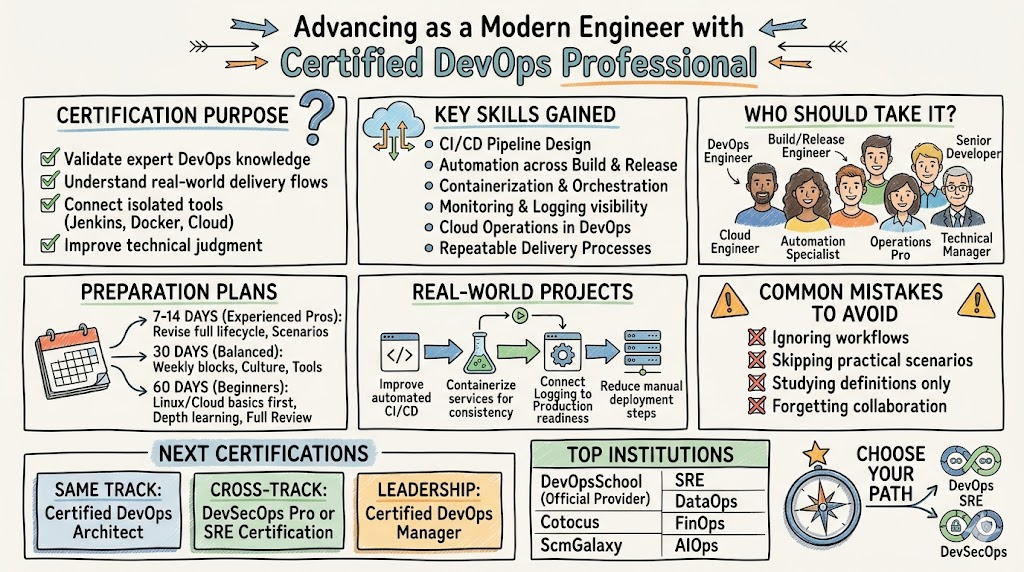
The DevOps Certified Professional (DCP) is an advanced, practitioner-level certification that confirms an individual’s expertise in the end-to-end DevOps lifecycle. Unlike basic certifications that focus on a single cloud provider or a specific tool, the DCP focuses on the integrated ecosystem. It validates your proficiency in CI/CD, Containerization, Infrastructure as Code (IaC), Observability, and Site Reliability Engineering (SRE) principles.
Why it Matters in Today’s Software, Cloud, and Automation Ecosystem
As the complexity of cloud-native environments has exploded, modern organizations find themselves managing thousands of microservices across intricate multi-cloud landscapes. To navigate this scale, the Automation Mandate dictates that manual intervention is no longer an option but a point of failure; consequently, DCP practitioners are trained to treat “Infrastructure as Code,” ensuring that every environment is fully reproducible and version-controlled. This technical rigor provides the Velocity Edge, directly tying business success to the speed of innovation by providing a framework that slashes the “Lead Time for Changes” from months down to mere minutes. Ultimately, this approach fosters Resilience by Design, moving beyond simple deployment to build “Self-Healing” systems capable of detecting and recovering from failures autonomously, ensuring stability without the need for constant human intervention.
Why Certifications are Important for Engineers and Managers
For Engineers:
A certification like DCP acts as a “Technical Passport.” It bypasses the ambiguity of a resume by providing a verified benchmark of your skills. It signals to employers that you have moved beyond “YouTube learning” and have mastered a structured, industry-validated body of knowledge.
For Managers:
For leadership, certifications are a risk-mitigation tool. When you hire or promote a DCP-certified professional, you are ensuring that your team leaders follow standardized best practices, reducing the likelihood of catastrophic production errors and ensuring a common technical vocabulary across the organization.
Why Choose DevOpsSchool?
Selecting the right partner for your DCP journey is a critical decision that directly impacts your professional trajectory. DevOpsSchool has emerged as a global leader in this space by prioritizing a “Lab-First” approach that emphasizes practical depth over mere theory. Rather than simply defining tools like a Jenkinsfile, their curriculum requires students to build robust configurations capable of handling complex blue-green deployments for microservices. This hands-on rigor is supported by a real-world faculty of active consultants who bring invaluable “war stories” and experience from solving actual production outages into the classroom. Furthermore, they offer a comprehensive ecosystem that supports a lifelong learning journey, extending far beyond initial certification into specialized tracks for Security, Data, and AI operations.
About Certification: DevOps Certified Professional (DCP)
What it is
The DCP is an intensive validation program that covers the architectural and operational aspects of DevOps. It is designed to transform “Traditional Engineers” into “Automation Architects” who can design, implement, and manage high-velocity delivery pipelines.
Who should take it
This program is specifically tailored for Senior Software Engineers, System Administrators, Cloud Architects, Build/Release Engineers, and IT Managers who are responsible for the digital output of their organizations.
Skills You’ll Gain
- Advanced CI/CD Orchestration: Designing pipelines that include automated unit tests, integration tests, and performance gates.
- Container Mastery: Deep understanding of Docker networking, storage, and security.
- Kubernetes Administration: Managing pods, deployments, services, and ingress controllers in a production-grade cluster.
- Declarative Infrastructure: Mastering Terraform for multi-cloud provisioning and Ansible for configuration management.
- Proactive Monitoring: Implementing “Golden Signals” of monitoring (Latency, Traffic, Errors, Saturation) using Prometheus and Grafana.
- Shift-Left Security: Integrating SAST/DAST and container scanning into the delivery flow.
Real-World Projects You Should Be Able to Do
- The “One-Click” Production Environment: Build a Terraform script that spins up a VPC, EKS cluster, and RDS database in a single command.
- Automated Rollback Systems: Configure a CI/CD pipeline that automatically rolls back a deployment if error rates exceed a certain threshold.
- Secure Secret Management: Implement HashiCorp Vault to ensure no passwords or API keys are ever stored in plain text or Git.
- Log Aggregation System: Build a centralized logging platform using the ELK stack (Elasticsearch, Logstash, Kibana) to debug distributed microservices.
The Master Certification Table (DevOps & Beyond)
| Track | Level | Who it’s for | Prerequisites | Skills Covered | Recommended Order |
| DevOps | Professional | Engineers, Admins | Linux, Git | CI/CD, K8s, Terraform | 1st |
| DevSecOps | Specialist | Security Ops | DCP Foundation | Vault, SonarQube, OPA | 2nd |
| SRE | Specialist | Reliability Eng | DCP Foundation | SLIs/SLOs, Chaos Eng | 2nd |
| AIOps/MLOps | Specialist | ML/Data Eng | Python, DevOps | ML Pipelines, Model Ops | 3rd |
| DataOps | Specialist | Data Engineers | SQL, DevOps | Data CI/CD, ETL Auto | 3rd |
| FinOps | Specialist | Managers, Leads | Cloud Basics | Cost Optimization | 2nd |
Preparation Plans for DCP Mastery
Success in the DCP exam requires a blend of conceptual clarity and “muscle memory” developed through hands-on practice.
7–14 Days: The “Sprint” Plan (For Experienced DevOps Engineers)
This is for those who are already working with these tools but need to formalize their knowledge.
- Days 1-4: Focus on the gaps. If you use Jenkins, spend this time on GitLab CI. If you know Docker, deep dive into Kubernetes networking.
- Days 5-10: Practice “Hardening.” Learn how to secure your CI/CD pipelines and IaC scripts.
- Days 11-14: Practice time-bound lab scenarios. Take mock exams to get used to the question patterns.
30 Days: The “Marathon” Plan (For Developers/SysAdmins)
This is the most common path for those transitioning into a full-time DevOps role.
- Week 1: Core Fundamentals. Master Linux shell scripting, Git branching strategies (Gitflow vs Trunk-based), and Networking basics.
- Week 2: The Container Era. Spend 2 hours daily building Dockerfiles, optimizing image sizes, and running multi-container apps with Docker Compose.
- Week 3: Orchestration & IaC. Focus exclusively on Kubernetes (deployments/services) and Terraform (state management/modules).
- Week 4: The Feedback Loop. Set up Prometheus alerts and Grafana dashboards. Integrate SonarQube for code quality.
60 Days: The “Foundation” Plan (For Beginners/Freshers)
- Month 1: Focus on “The Ecosystem.” Understand how the web works, how servers communicate, and how software is built. Learn Python and Bash.
- Month 2: Tool Mastery. Dedicate one week each to CI/CD, Containers, Kubernetes, and Cloud. Spend the final two weeks building a “Capstone Project” that connects all these tools.
Common Mistakes to Avoid
- Tool-Obsession: Don’t just learn “how to use Jenkins.” Learn “why we use CI/CD.” Tools change; principles stay.
- Ignoring the Terminal: You cannot be a DevOps professional if you are afraid of the command line. Master the CLI.
- Neglecting Documentation: In the exam and in real life, your ability to document your “Infrastructure as Code” is just as important as the code itself.
- Skipping the “Soft” Side: DevOps is about empathy and collaboration. If you ignore the cultural modules of the DCP, you will fail as a lead.
Choose Your Path: 6 Learning Tracks
1. The DevOps Path (The Generalist)
The most versatile path. You become the bridge between all technical teams, focusing on the seamless flow of code from a developer’s laptop to a production server.
2. The DevSecOps Path (The Security Champion)
Focuses on “Security as Code.” You learn how to automate compliance and vulnerability management so that security is a feature, not a hurdle.
3. The SRE Path (The Reliability Expert)
Focuses on the “Ops” side of DevOps using a “Dev” mindset. You manage availability, latency, and performance using software engineering principles.
4. The AIOps/MLOps Path (The Data Scientist’s Partner)
Focuses on the unique challenges of deploying Machine Learning. You manage data versioning, model drift, and high-compute training environments.
5. The DataOps Path (The Information Architect)
Focuses on the delivery of data. You ensure that data pipelines are as robust and automated as software pipelines.
6. The FinOps Path (The Cloud Economist)
Focuses on the “Value” of DevOps. You ensure that as the company scales, the cloud costs stay optimized and aligned with business growth.
Role → Recommended Certifications Mapping
| Role | Entry / Foundational | Intermediate / Core | Advanced / Mastery |
| DevOps Engineer | DCP | CKA (Administrator) | AWS/Azure DevOps Engineer |
| SRE | DCP | SRE Certified | Chaos Engineering Practitioner |
| Platform Engineer | DCP | Terraform Associate | CKA $\rightarrow$ CKAD |
| Security Engineer | DCP | DevSecOps Certified | CCSP (Cloud Security) |
| Data Engineer | DCP | DataOps Certification | Big Data Specialty |
| FinOps Practitioner | Cloud Practitioner | FinOps Certified | — |
| Engineering Manager | DCP | FinOps | Agile Leadership |
Next Certifications to Take
Once you achieve your DCP, the world opens up. Based on current data from Gurukulgalaxy, these are the most strategic next steps:
- Same Track (Specialization): Become a master of the orchestration layer with the Certified Kubernetes Administrator (CKA).
- Cross-Track (Versatility): Gain the “Protector” status by taking the DevSecOps Certified Professional exam.
- Leadership (Growth): Move toward a CTO or Architect role by mastering FinOps and Cloud Architecture.
Top Training Institutions for DCP
DevOpsSchool
This provider is a leader in the DevOps education space, offering deep technical bootcamps and certification support for a global audience. They focus on providing hands-on labs that simulate real-world production environments, ensuring that students gain practical experience. Their instructors are seasoned industry veterans who provide mentorship beyond the curriculum, helping engineers solve actual work challenges during the training process.
Cotocus
A specialized training and consulting firm that focuses on high-end engineering practices and digital transformation. They provide tailored learning paths for enterprises and individuals looking to master complex toolchains. Their approach is highly practical, emphasizing the integration of security tools within existing workflows to achieve a true DevSecOps culture in large-scale organizations.
Scmgalaxy
As one of the largest communities for DevOps and SCM professionals, this provider offers a wealth of resources, including free tutorials and premium certification support. They are known for their community-driven approach to learning, where professionals can share insights and stay updated on the latest trends in software configuration and security automation.
BestDevOps
This platform offers curated training programs designed to help engineers move from foundational knowledge to advanced architectural mastery. They emphasize the career impact of certifications, providing students with the technical skills and the professional guidance needed to secure top-tier roles in the tech industry globally.
devsecopsschool.com
This is the official platform for the Certified DevSecOps Engineer program, offering direct access to the curriculum and certification exams. It provides a comprehensive ecosystem for learners, including study materials, practice labs, and official documentation. The site serves as the primary hub for professionals looking to validate their expertise through a recognized industry standard.
sreschool.com
Focusing on the intersection of reliability and security, this provider offers specialized training for Site Reliability Engineers. Their modules cover how to build resilient systems that can withstand both traffic spikes and security incidents. They provide deep dives into observability and automated response, which are critical for maintaining modern distributed systems.
aiopsschool.com
This provider is at the forefront of the AIOps movement, teaching engineers how to leverage artificial intelligence for IT operations. Their curriculum includes using AI to detect security threats and automate operational decision-making. It is an ideal resource for those looking to stay ahead of the curve in automated system management.
dataopsschool.com
A dedicated training site for data professionals who need to implement security and operations best practices within their data pipelines. They cover the unique challenges of securing large-scale data environments and ensuring compliance with global data protection laws through automation and rigorous testing.
finopsschool.com
This platform provides training on cloud financial management, helping professionals optimize their cloud spend while maintaining a secure infrastructure. They teach the essential skills of balancing cost, speed, and security, which is a growing requirement for modern cloud-native enterprises looking to maximize their ROI.
FAQs: Career & Outcomes
Frequently Asked Questions (FAQs)
1. How difficult is the DCP exam compared to other IT certifications?
The DCP is a practitioner-level exam, making it more challenging than entry-level “Foundation” certificates. It focuses on scenario-based problem-solving rather than rote memorization, requiring you to understand how tools interact in a live production environment.
2. How much time does it take to prepare for the DCP?
For working professionals with some IT background, 30 to 45 days of consistent study (10–12 hours per week) is typical. Absolute beginners should plan for a 60-to-90-day roadmap to first master Linux and networking fundamentals.
3. What are the mandatory prerequisites for this certification?
There are no formal academic prerequisites, but a functional understanding of the Linux Command Line (CLI) and basic networking concepts (IP addressing, DNS, Ports) is highly recommended to keep pace with the curriculum.
4. In what sequence should I learn the tools?
The recommended “Golden Path” is: 1. Linux & Git (Foundations), 2. Docker (Containerization), 3. Jenkins (CI/CD), 4. Terraform (IaC), and finally 5. Kubernetes (Orchestration). Learning in this order mimics the actual flow of a software bit through a pipeline.
5. What is the market value of a DCP certification in 2026?
The DCP is a high-value credential because it is vendor-neutral. Unlike AWS-only or Azure-only certs, the DCP proves you can manage infrastructure across any cloud or on-premise environment, making you a versatile asset for any global firm.
6. Will this certification help me get a remote job?
Yes. DevOps is inherently built for remote-first environments. Mastering the DCP tools (GitOps, Terraform, Kubernetes) proves you can manage complex global infrastructure without needing physical access to a data center.
7. Can a Manual QA or System Admin switch to DevOps via DCP?
Absolutely. Many DCP aspirants come from QA or SysAdmin backgrounds. The course provides the automation and scripting bridge needed to transition from manual testing or server management to automated “Operations as Code.”
8. How does DCP impact my salary expectations?
Certified DevOps Professionals in 2026 typically command salaries 30% to 50% higher than traditional developers or admins. In many regions, Platform Engineering (the evolution of DevOps) remains one of the highest-paying technical roles.
9. Should I take DCP before or after a Cloud-specific cert (like AWS)?
Take DCP first. DCP teaches you the methodology and the toolchain. Once you understand how to build a pipeline with Terraform and Kubernetes, applying those skills to AWS, Azure, or GCP is a simple matter of learning a new provider’s interface.
10. What are the long-term career outcomes after DCP?
DCP is a gateway to elite roles such as Site Reliability Engineer (SRE), Platform Architect, DevSecOps Lead, or Engineering Manager. It provides the technical “street cred” needed to move into high-level architectural decision-making.
11. Is coding knowledge required to pass?
You don’t need to be a software developer, but you must be comfortable with “Logical Scripting.” Being able to read and write YAML, JSON, and basic Bash or Python scripts is essential for success in the DCP exam.
12. Does the DCP certification expire?
While the certification itself provides a lifelong foundation, the DevOps ecosystem moves fast. It is a best practice to pursue an advanced specialization (like SRE or DevSecOps) every two years to ensure your skills remain at the cutting edge.
FAQs: DevOps Certified Professional (DCP) Specifics
1. What are the core topics covered in the DCP exam?
The exam covers CI/CD pipelines, Container Management (Docker), Orchestration (Kubernetes), IaC (Terraform/Ansible), and Continuous Monitoring.
2. Is there a lab requirement for the certification?
To be “Professional” certified, you must demonstrate completion of the required lab hours and the final capstone project.
3. Who issues the DCP certification?
It is an industry-recognized credential issued by DevOpsSchool.com and its affiliated training partners.
4. Can I attend the training in person?
While most training is now virtual and live, some partners like Cotocus offer in-person corporate workshops.
5. Does DCP cover AWS or Azure?
It is cloud-agnostic. It teaches you the skills that work on any cloud, though labs typically use AWS or Azure as the “host” for the infrastructure.
6. What happens if I don’t pass on my first attempt?
Most training programs include a “Retake Guarantee,” allowing you to study the areas where you were weak and take the exam again.
7. Is the certification recognized in Europe and the US?
Yes, the syllabus is aligned with the global “DevOps Institute” standards and is recognized by international recruiters.
8. How do I verify someone’s DCP certification?
Each certificate comes with a unique ID and a verification URL on the official provider’s website.
Conclusion
The DevOps Certified Professional (DCP) is more than just a line on a resume; it is a fundamental shift in how you view software engineering. By mastering this curriculum, you move from being a “component of the machine” to becoming the “architect of the factory.”
Whether you are an engineer looking for that next big salary jump or a manager trying to modernize a legacy team, the DCP path offers the most structured and rewarding journey in the current tech market. The tools will evolve, but the principles of automation, collaboration, and rapid feedback you learn here will define your career for the next decade.
Take the leap. Start your DCP journey today and become the engineer that every modern company is searching for.