Introduction
Modern software teams are expected to deliver two things at the same time: speed and stability. Businesses want frequent releases, faster delivery, lower downtime, better customer experience, and stronger platform performance. Users expect applications to work smoothly all the time. They do not care how complex the backend is. They only notice whether the service is fast, available, and dependable.
This is why reliability has become a serious engineering priority.
A few years ago, many companies treated operations as a support layer that stepped in after deployment. That model is no longer enough. Today, software runs across cloud platforms, containers, microservices, APIs, CI/CD pipelines, and distributed environments. Systems are larger, dependencies are deeper, and the cost of failure is higher. A small issue in one service can quickly affect many teams and many users.
That is where Site Reliability Engineering, or SRE, becomes highly valuable.
SRE helps organizations build a more disciplined way of running services. It combines software engineering thinking with operational responsibility. Instead of depending only on manual intervention, it encourages automation, measurable service goals, better observability, thoughtful alerting, and strong incident response. It helps teams reduce noise, lower operational stress, and make reliability part of day-to-day engineering.
For working engineers and managers, this is not just another technical topic. It is a practical skill area that directly affects delivery quality, customer trust, platform maturity, and career growth.
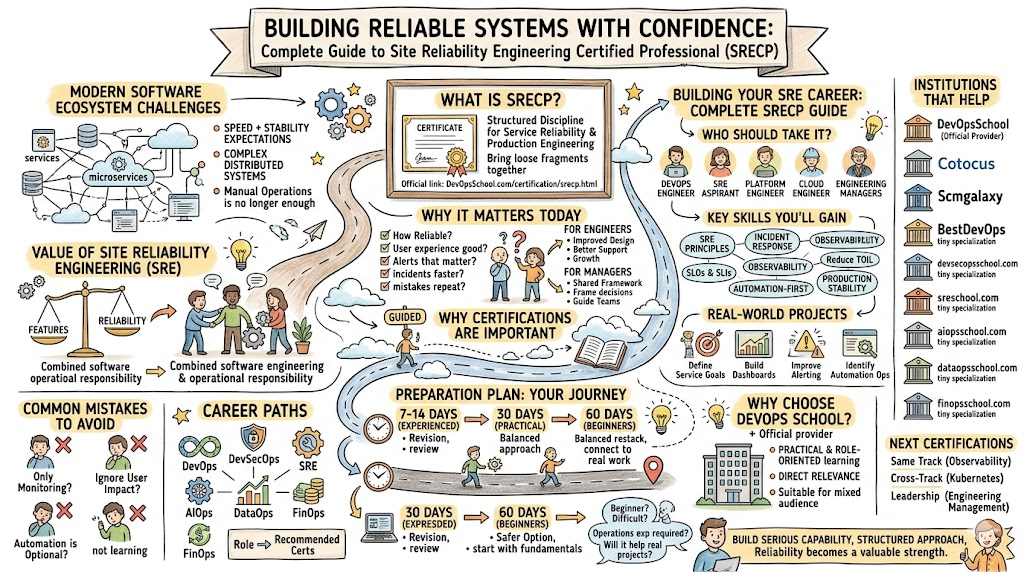
The Site Reliability Engineering Certified Professional, or SRECP, is a certification designed for professionals who want a structured path into this field. It helps learners understand how reliability is measured, improved, and managed in modern systems. More importantly, it helps them connect these ideas to real-world engineering work.
This guide explains the SRECP certification in a fresh and practical way. It covers what the certification is, why it matters, who should pursue it, why certifications are useful, how to prepare, which career paths connect well with it, and what certifications may come next.
What is Site Reliability Engineering Certified Professional (SRECP)?
Site Reliability Engineering Certified Professional is a professional certification built for people who want to develop strong knowledge in service reliability, operational discipline, and production engineering practices.
In simple language, it teaches professionals how to keep systems healthy in the real world.
That may sound like a small goal, but in modern software environments it involves many connected areas. A reliable system is not created by luck. It is built through good design, smart monitoring, clear service expectations, controlled change management, faster recovery practices, and strong automation. SRECP helps learners understand how these pieces fit together.
One of the biggest reasons this certification matters is that many engineers already work around reliability without having a complete framework for it. A DevOps engineer may know automation and deployment. A cloud engineer may understand infrastructure and availability. A platform engineer may handle internal systems and service operations. A manager may be responsible for uptime and incident escalation. Yet many of these professionals still learn reliability in fragments.
SRECP helps bring those fragments together.
It turns reliability from a loose idea into a structured discipline. Instead of only reacting when something fails, professionals learn how to think in terms of service behavior, service targets, operational maturity, failure prevention, and customer impact.
That shift in thinking is what gives SRECP real career value.
Official certification link: https://www.devopsschool.com/certification/sre-certified-professional-srecp.html
Why it Matters in Today’s Software, Cloud, and Automation Ecosystem
The software world has changed in a major way. Applications are no longer simple monoliths running in one place. Teams now work with distributed services, container orchestration, managed cloud platforms, infrastructure as code, automated deployments, observability stacks, and real-time production monitoring. While this has improved scalability and speed, it has also increased operational complexity.
This complexity creates a new problem.
When systems become more dynamic, reliability becomes harder to maintain using old methods. Manual operations, reactive support, and unclear ownership are not enough in fast-moving environments. Teams need a method for keeping services stable without slowing down progress.
SRE offers that method.
It helps teams answer practical questions such as:
- How reliable should this service actually be?
How do we measure whether users are getting a good experience?
How do we avoid wasting time on alerts that do not matter?
How much manual work should operations teams still do?
How do we recover from incidents faster?
How do we make sure the same issue does not repeat again and again?
These questions are not only technical. They affect business performance as well. Poor reliability leads to customer frustration, revenue loss, missed deadlines, exhausted teams, and lower trust in engineering. Strong reliability creates better products, healthier on-call practices, more stable releases, and better platform confidence.
For engineers, SRE improves the way systems are designed, observed, supported, and improved.
For managers, SRE provides a better way to discuss service quality, risk, performance, operational effort, and business impact.
That is why Site Reliability Engineering is now seen as a critical capability in modern software organizations.
Why Certifications are Important for Engineers and Managers
Learning from real work is important, but real work alone does not always create complete understanding. Many professionals become skilled in one area while remaining weak in another. Someone may be strong in dashboards and alerts but weak in service-level thinking. Another person may know infrastructure automation but not understand incident strategy. Another may be good at handling outages but have little clarity around operational objectives.
This is where certification helps.
A good certification creates structure. It gives professionals a guided path so they can learn in the right order and connect different concepts into one practical model. It helps them move from scattered knowledge to a stronger and more complete understanding.
For engineers, certification can do three important things.
First, it gives direction. Instead of jumping between random topics, professionals can follow a purposeful learning path.
Second, it improves confidence. Many engineers already do part of the job, but a certification helps them understand the bigger picture behind their daily work.
Third, it supports career growth. When a role-relevant certification is combined with hands-on work, it becomes easier for hiring managers and employers to see where that professional is headed.
For managers, certification also has clear value.
Managers need common language and shared frameworks. They need a way to discuss service reliability, team readiness, on-call maturity, operational risk, and long-term improvements. Certification helps managers understand these areas more clearly and guide teams more effectively.
A certificate by itself does not create expertise. Real expertise still comes from doing the work. But a strong certification can make that work more focused, more visible, and more meaningful.
Why Choose DevOpsSchool?
Choosing the right provider matters because the value of a certification depends heavily on how the subject is taught.
DevOpsSchool is often selected by professionals who prefer practical and role-oriented learning. That matters a lot in a field like Site Reliability Engineering. Reliability cannot be understood properly through terms alone. Learners need context. They need to understand why reliability matters, how it is measured, what mistakes teams make, and how engineering decisions affect production systems.
Another reason DevOpsSchool stands out is relevance. Many learners do not want academic-style content that feels distant from real work. They want learning that connects directly to cloud systems, platform operations, delivery pipelines, observability, incident handling, and production support. A provider that understands these realities usually adds more value.
DevOpsSchool is also suitable for a mixed audience. It can help hands-on engineers who want technical depth, and it can also support managers who need a stronger understanding of service reliability and operational maturity without losing the practical connection.
For professionals who want career-relevant learning and a certification that fits real engineering roles, that is an important advantage.
Certification Deep-Dive: Site Reliability Engineering Certified Professional (SRECP)
What is this certification?
SRECP is a professional certification focused on reliability engineering in modern software environments. It teaches professionals how to think about service stability, incident readiness, monitoring quality, automation, and operational excellence as one connected discipline.
This certification is not only about keeping systems running. It is about understanding how reliable services are built, supported, measured, and improved over time.
Who should take this certification?
This certification is suitable for a broad group of professionals.
It is a strong fit for DevOps engineers who want to move deeper into production reliability.
It is valuable for SRE aspirants who want a structured path into the field.
It works well for platform engineers who are responsible for shared systems and service health.
It supports cloud engineers who manage uptime, performance, and operational readiness.
It can also help operations professionals who want to move away from purely manual support work and develop a more engineering-led approach.
Engineering managers can benefit too, especially if they are responsible for service quality, escalation processes, team maturity, and operational improvement.
Certification Overview Table
| Certification Name | Track | Level | Who it’s for | Prerequisites | Skills Covered | Recommended Order | Link |
|---|---|---|---|---|---|---|---|
| Site Reliability Engineering Certified Professional (SRECP) | SRE | Professional | DevOps engineers, SRE aspirants, platform engineers, cloud engineers, operations professionals, engineering managers | Basic exposure to Linux, cloud, CI/CD, monitoring, and production support is helpful | Reliability engineering, service objectives, observability, incident handling, automation, operational discipline, production stability | A solid first step in the SRE path | https://www.devopsschool.com/certification/sre-certified-professional-srecp.html |
Site Reliability Engineering Certified Professional (SRECP)
What it is
SRECP is a certification designed to help professionals understand how reliability should be handled in modern software systems. It builds a strong foundation in service thinking, operational quality, and production engineering practices.
It is ideal for professionals who want to move from task-based operations to reliability-focused engineering.
Who should take it
- DevOps engineers
- SRE aspirants
- Platform engineers
- Cloud engineers
- Operations professionals
- System administrators
- Technical leads
- Engineering managers
- Software engineers working near production systems
Skills you’ll gain
- Understanding of core Site Reliability Engineering principles
- Clearer thinking around service health and service expectations
- Better knowledge of incident response and escalation flow
- Stronger observability awareness
- Better understanding of reliability measurement
- Improved automation-first mindset
- Greater clarity on balancing speed and stability
- Better awareness of operational toil and how to reduce it
- Stronger production support thinking
- Improved ability to connect engineering work with customer impact
Real-world projects you should be able to do after it
- Define service goals for an application or internal platform
- Create basic reliability dashboards for operations review
- Improve alert quality and reduce unnecessary alert noise
- Design a simple incident-handling process
- Review repeated operational pain points and identify automation opportunities
- Support production readiness for changes and releases
- Improve visibility into service performance and system behavior
- Introduce service-level thinking into team discussions
- Help a platform team build more dependable operational practices
- Contribute to reliability improvement efforts for critical services
Preparation plan
7–14 days
This is best for professionals who already work in DevOps, cloud, operations, or platform roles. Use this time mainly for focused revision. Review reliability fundamentals, service-level ideas, observability basics, incidents, and automation use cases. This works only if you already have strong exposure to production systems.
30 days
This is the most practical path for most professionals. Spend the first part understanding the concepts clearly. Use the second part to connect those concepts with real work scenarios. Keep the final part for revision, note-making, and practical review. This plan gives enough time to understand the topic instead of only memorizing it.
60 days
This is the safer option for beginners and career changers. Start with Linux, cloud basics, containers, monitoring, CI/CD, and operations fundamentals. Then move into SRE principles, service reliability, observability, incident handling, and automation. End with revision and small practical exercises.
Common mistakes
- Thinking SRE is only about monitoring
- Focusing on tools without understanding principles
- Ignoring service goals and user impact
- Treating incidents as isolated events instead of learning opportunities
- Studying theory without practical scenarios
- Forgetting that automation is central to reliability work
- Looking only at outages and not at prevention
- Preparing without connecting concepts to real production environments
Best next certification after this
The best next move depends on your direction.
If you want to stay in the same space, an observability-focused certification is a strong option.
If you want deeper platform and infrastructure knowledge, a Kubernetes-related certification makes sense.
If you want to move toward broader ownership and leadership, a DevOps or management-oriented certification can be the right next step.
Choose your path
DevOps path
This path is for professionals focused on automation, CI/CD, infrastructure management, and delivery systems. SRECP strengthens this path by adding reliability depth and helping engineers think beyond deployment into long-term service health.
DevSecOps path
This path fits professionals working at the intersection of software delivery and security. SRECP adds resilience, incident discipline, and stronger operational thinking, which helps security-focused teams manage reliable systems as well as secure ones.
SRE path
This is the most natural path for professionals who want to specialize in uptime, service quality, observability, incidents, and operational maturity. SRECP is a strong starting point for this track.
AIOps/MLOps path
This path is useful for professionals working with intelligent operations, automated decision support, or machine learning systems. SRECP adds the reliability foundation that these advanced environments still require.
DataOps path
Data systems also depend on stable pipelines, dependable platforms, and predictable operational behavior. SRECP helps DataOps professionals bring stronger service thinking into data workflows and platform reliability.
FinOps path
FinOps focuses on cloud efficiency and financial discipline. SRECP supports this path because unstable systems often create waste, repeated recovery effort, and poor resource use. Better reliability often supports better efficiency too.
Role → Recommended certifications mapping
| Role | Recommended certifications |
|---|---|
| DevOps Engineer | SRECP, DevOps-focused certifications, Kubernetes-related learning |
| SRE | SRECP first, then observability and advanced reliability certifications |
| Platform Engineer | SRECP plus Kubernetes, Terraform, and platform engineering learning |
| Cloud Engineer | SRECP plus cloud operations or architecture certifications |
| Security Engineer | DevSecOps certifications first, then SRECP for resilience depth |
| Data Engineer | DataOps learning plus SRECP for operational reliability |
| FinOps Practitioner | FinOps learning plus SRECP for efficiency and service stability alignment |
| Engineering Manager | SRECP plus leadership-focused DevOps, SRE, or platform strategy certifications |
Next certifications to take
Same track
An observability-focused certification is a smart next step after SRECP. Once you understand reliability at a service level, deeper skill in metrics, logs, traces, dashboards, and telemetry becomes very valuable.
Cross-track
A Kubernetes-related certification is a strong cross-track option. Many production systems now run in containerized environments, so this can make your reliability knowledge more practical and more useful in real projects.
Leadership
A DevOps or engineering-management-focused certification is a useful leadership step. It fits professionals who want to move from hands-on reliability work into broader platform ownership, team leadership, and delivery strategy.
Institutions that help in training cum certifications for Site Reliability Engineering Certified Professional (SRECP)
DevOpsSchool
DevOpsSchool is the direct provider of the SRECP certification and is the most relevant option for learners who want training aligned with the official program. It is well suited for working engineers, managers, and teams looking for practical growth in Site Reliability Engineering.
Cotocus
Cotocus can be useful for professionals looking for technical learning support connected to cloud, automation, and engineering implementation. It may be helpful for learners who want practical exposure while building reliability-related skills.
Scmgalaxy
Scmgalaxy is known for technology learning around tools, DevOps, and automation. It can help learners who want to build stronger foundations before going deeper into specialized reliability work.
BestDevOps
BestDevOps is often recognized in the wider DevOps and cloud learning ecosystem. It can support professionals exploring structured learning in automation, infrastructure, and engineering practices that connect well with reliability careers.
devsecopsschool.com
This platform is useful for learners who want to combine reliability thinking with secure delivery practices. It supports professionals working in environments where resilience and security need to work together.
sreschool.com
SRESchool is naturally relevant for people who want focused growth in reliability engineering. It can help learners develop stronger understanding in observability, incidents, service health, and operational maturity.
aiopsschool.com
AIOpsSchool is a suitable option for professionals interested in AI-driven operations and intelligent automation. It can complement SRE learning for those who want to explore the future direction of operations.
dataopsschool.com
DataOpsSchool is useful for learners working with data platforms, data pipelines, and analytics operations. It can support professionals who want stronger operational quality in data-heavy environments.
finopsschool.com
FinOpsSchool is relevant for professionals focused on cloud cost efficiency, governance, and optimization. For learners who want to balance reliability with better cost awareness, this can be a useful complementary area.
FAQs
1. Is SRECP a beginner certification?
It is better seen as a professional-level certification. Beginners can still prepare for it, but they will usually need a longer study plan and stronger fundamentals.
2. How difficult is SRECP?
The difficulty is moderate to high depending on your background. It is easier for professionals who already work with cloud, DevOps, monitoring, or production support.
3. How much time should I spend preparing?
For many working professionals, 30 days is a practical plan. Experienced engineers may need less, while beginners may need around 60 days.
4. Do I need prior operations experience?
It helps, but it is not the only useful background. DevOps, cloud engineering, platform work, system administration, and backend software roles can all support SRE learning.
5. Is SRECP useful for software engineers?
Yes. Software engineers who work close to production systems can gain strong value from learning how reliability is managed and improved.
6. Is it only for people with the SRE title?
No. It is useful across multiple roles including DevOps, platform engineering, cloud operations, and technical management.
7. Does SRECP help with career growth?
Yes. It can improve your profile for roles that require stronger production reliability thinking and operational maturity.
8. Is this certification useful for managers?
Yes. Managers benefit because it helps them understand service quality, incident readiness, risk, and operational decision-making more clearly.
9. What should I study before starting?
Linux basics, cloud concepts, monitoring, containers, CI/CD, and production support fundamentals are all helpful starting points.
10. Is SRECP only about monitoring and alerts?
No. Monitoring is only one part of reliability work. The certification also relates to service goals, incident response, automation, operational discipline, and system behavior.
11. Should I take Kubernetes certification before SRECP?
That depends on your role. If your job is more reliability-focused, SRECP is a strong first step. If your daily work is very Kubernetes-heavy, either path can work well.
12. Will SRECP help in real projects?
Yes. Its value becomes stronger when you apply it to dashboards, alerts, incidents, automation, and service reliability improvements in actual systems.
FAQs on Site Reliability Engineering Certified Professional (SRECP)
1. What does SRECP stand for?
It stands for Site Reliability Engineering Certified Professional.
2. What is the main goal of this certification?
Its main goal is to help professionals understand and apply reliability engineering practices in modern production environments.
3. Is SRECP useful for DevOps engineers?
Yes. It is a strong next step for DevOps professionals who want deeper reliability and production knowledge.
4. Can managers benefit from this certification?
Yes. It helps managers develop a more structured view of uptime, operational readiness, and service maturity.
5. Is SRECP relevant for cloud-native systems?
Yes. Cloud-native environments are exactly where strong reliability practices become very important.
6. What makes this certification different from general operations learning?
It focuses on engineering-led reliability rather than only support tasks and reactive troubleshooting.
7. Is SRECP worth it for platform engineers?
Yes. Platform engineers can use it to improve service quality, operational consistency, and system dependability.
8. What is the biggest value of SRECP?
Its biggest value is helping professionals move from fragmented operational knowledge to a clearer, more complete reliability mindset.
Conclusion
The Site Reliability Engineering Certified Professional certification is a strong choice for professionals who want to build serious capability in modern reliability work. It does not stay limited to one tool, one platform, or one narrow operations task. Instead, it helps learners understand how service health, observability, incidents, automation, and system stability connect in real engineering environments. That makes it highly useful for DevOps engineers, SRE aspirants, cloud professionals, platform teams, and engineering managers. In a technology world where users expect software to be fast, stable, and always available, reliability has become one of the most valuable engineering strengths. SRECP gives professionals a structured and practical path to build that strength and use it in meaningful roles.
