Introduction
Large organizations are no longer asking whether they should adopt DevOps. The real question is how to scale delivery, control risk, improve release quality, and modernize cloud operations across many teams at the same time.
That is where AWS DevOps Engineer – Professional becomes relevant. AWS describes this certification as validating the ability to automate testing and deployment of AWS infrastructure and applications, which aligns closely with how enterprises build repeatable cloud delivery models.
It is useful in environments where one platform may support dozens of product teams, multiple business units, strict compliance requirements, and nonstop release expectations.
In large companies, DevOps maturity is not only about faster deployment. It is about creating stable release pipelines, standard governance, automated controls, clear monitoring, and recovery patterns that work across regions, departments, and application portfolios. The DevOpsSchool program for AWS DevOps Engineer – Professional is also framed around these core areas, including CI/CD, monitoring, event handling, governance, and resilient cloud operations.
What it is AWS Certified DevOps Engineer – Professional
The AWS Certified DevOps Engineer – Professional serves as a master-level validation for cloud experts who specialize in the automated lifecycle of modern software. It confirms your proficiency in merging development and operations to build robust, autonomous systems that can deploy, monitor, and maintain themselves with minimal human intervention. By mastering this track, you demonstrate the technical maturity required to implement sophisticated governance policies, multi-tier security guardrails, and rapid-response disaster recovery strategies, essentially proving you can oversee the entire digital supply chain within the AWS ecosystem at a global scale.
Why it Matters in Today’s Software, Cloud, and Automation Ecosystem
In today’s hyper-competitive digital landscape, the shift toward a decentralized, cloud-native ecosystem has made rapid, reliable delivery a baseline requirement rather than a luxury. Businesses now operate in a world where infrastructure is treated as code and security must be “shifted left” to mitigate global threats, making the ability to automate the entire software development lifecycle (SDLC) critical for survival. The AWS Certified DevOps Engineer – Professional credential matters because it bridges the gap between high-level architectural design and boots-on-the-ground operational excellence, providing engineers with the skills to build self-healing, cost-optimized systems that can scale instantly to meet global demand while maintaining rigorous compliance standards.
Why Choose DevOpsSchool?
DevOpsSchool stands out as a premier training destination because it prioritizes a mentor-led, project-based learning philosophy that bridges the gap between theoretical cloud concepts and high-stakes production environments. By offering a curriculum designed by industry practitioners, they provide students with hands-on labs and real-world scenarios that mirror the complexities of the AWS Certified DevOps Engineer – Professional exam. This practical focus ensures that engineers don’t just memorize service features but master the actual automation, CI/CD, and troubleshooting skills required to lead digital transformations in the global job market.
What the Certification Covers
What it is
AWS DevOps Engineer – Professional is a professional-level certification and training path centered on provisioning, operating, and managing distributed application systems on AWS. The DevOpsSchool course page positions it around cloud automation, release engineering, monitoring, governance, security controls, and resilient production operations.
Who should take it
- Platform engineers designing shared CI/CD systems for multiple product teams.
- Cloud engineers moving from infrastructure support into standardized enterprise automation.
- DevOps leaders building release governance and deployment frameworks.
- SRE and operations teams responsible for service health, alerting, and recovery patterns.
- Security and compliance-aligned engineers who need to embed control points into delivery systems.
- Engineering managers leading cloud transformation initiatives and multi-team modernization programs.
Skills you will build
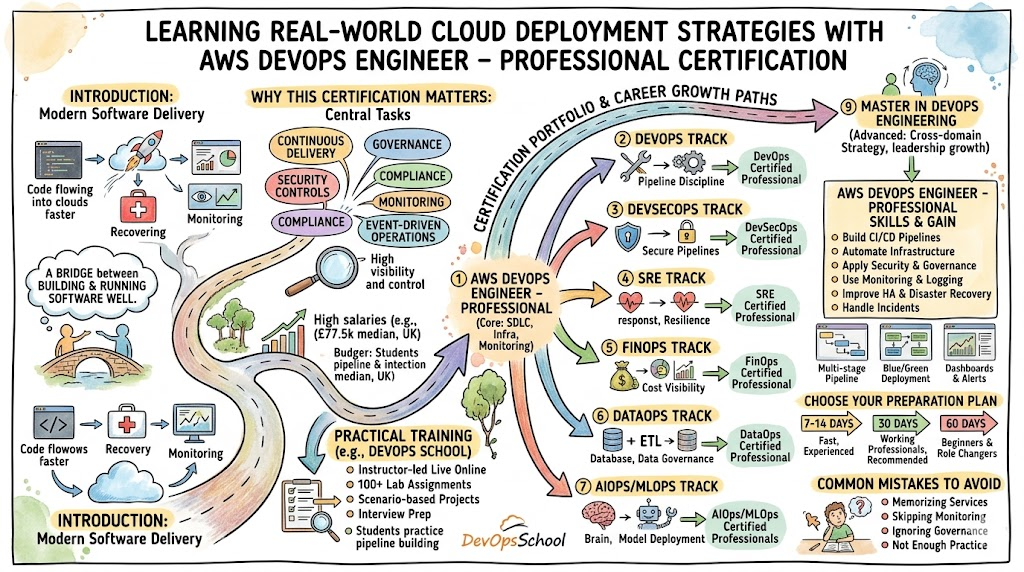
- Create enterprise-ready CI/CD pipelines using AWS-native delivery services.
- Automate infrastructure provisioning and operational workflows at scale.
- Apply governance, security controls, and compliance validation into release processes.
- Establish centralized logging, monitoring, alarms, and event-driven operational handling.
- Improve resilience with high-availability design, controlled rollouts, and self-healing principles.
- Support incident response with better observability and operational automation.
Real-world projects you should be able to do after it
- Standardize deployment pipelines for multiple application groups.
- Build release templates that reduce variation across development teams.
- Implement blue/green or canary rollout strategies for lower-risk releases.
- Set up organization-wide logging and alerting patterns.
- Automate policy checks for tagging, approvals, security, and deployment readiness.
- Design multi-AZ or multi-environment operational recovery approaches.
- Create event-driven remediation for recurring production issues.
Preparation roadmap
- 7–14 days
This path suits senior professionals who already work daily with AWS operations, IAM, deployment pipelines, monitoring, and infrastructure automation. The focus should be domain revision, architecture trade-offs, and scenario-based practice.
- 30 days
This is the best option for most enterprise engineers. Use week one for SDLC automation, week two for infrastructure and configuration workflows, week three for observability and governance, and week four for resilience, incident response, and mock scenarios.
- 60 days
This route works well for organizations planning team enablement. One month can be spent on concepts and labs, while the second month can focus on building a reusable pipeline, a monitoring model, and a recovery design that fits internal enterprise platforms.
Common mistakes
- Treating the certification as a service memorization exercise.
- Ignoring monitoring and incident response while over-focusing on build pipelines.
- Failing to connect governance with delivery automation.
- Learning tools separately instead of studying end-to-end release systems.
- Skipping hands-on exercises, which limits decision-making in complex scenarios.
Best next certification after this
- Same-track option: DevOps Certified Professional, for deeper process maturity and broader delivery discipline.
- Cross-track option: SRE Certified Professional or DevSecOps Certified Professional, depending on whether the next enterprise priority is reliability or secure delivery.
- Leadership option: Master in DevOps Engineering, for people responsible for platform strategy, cross-team operating models, and engineering transformation.
Certification Overview
Choose your path
- DevOps path: Best for organizations improving software flow, release automation, and deployment consistency.
- DevSecOps path: Best for enterprises where auditability, policy enforcement, and secure delivery must grow together.
- SRE path: Best for teams working on uptime, resilience, alert quality, and incident reduction across large estates.
- AIOps/MLOps path: Best for companies adding intelligent operations, ML delivery, or automation-assisted platform support.
- DataOps path: Best for enterprise data teams needing controlled, repeatable, and observable data movement.
- FinOps path: Best for cloud programs where engineering decisions must align with spend management and optimization.
Role to recommended certifications
| Role | Recommended certifications |
|---|---|
| DevOps Engineer | AWS DevOps Engineer – Professional → DevOps Certified Professional |
| SRE | AWS DevOps Engineer – Professional → SRE Certified Professional |
| Platform Engineer | AWS DevOps Engineer – Professional → SRE Certified Professional → leadership track |
| Cloud Engineer | AWS DevOps Engineer – Professional → DevOps Certified Professional |
| Security Engineer | AWS DevOps Engineer – Professional → DevSecOps Certified Professional |
| Data Engineer | AWS DevOps Engineer – Professional → DataOps Certified Professional |
| FinOps Practitioner | AWS DevOps Engineer – Professional → FinOps Certified Professional |
| Engineering Manager | AWS DevOps Engineer – Professional → Master in DevOps Engineering |
Training and certification support institutions
- DevOpsSchool is well suited for enterprise teams looking for structured labs, live mentoring, and practical certification-led upskilling.
- Cotocus is relevant for organizations that want cloud and DevOps capability building with a business-ready approach.
- Scmgalaxy is often considered for broad technical training across software delivery and automation disciplines.
- BestDevOps supports professionals and teams seeking certification-linked learning across modern engineering areas.
- devsecopsschool.com is useful for companies strengthening secure delivery practices.
- sreschool.com supports reliability, service operations, and incident-oriented learning paths.
- aiopsschool.com aligns with teams exploring intelligent operations and modern observability-led workflows.
- dataopsschool.com supports enterprise data teams building repeatable data platform operations.
- finopsschool.com is relevant for cloud cost governance and engineering-finance alignment.
General FAQs
1) Is this certification useful for a company, or only for an individual?
It is useful at both levels. For enterprises, the bigger advantage is creating a common framework for delivery automation, monitoring, and cloud operations.
2) When should an organization invest in this certification?
The best time is when cloud usage has already expanded and teams now need standardization, better control, and repeatable release systems.
3) Is this more relevant for platform teams than for developers?
Yes, platform and cloud operations teams usually gain the most immediate value, but development teams also benefit when enterprise delivery practices become more structured.
4) Does it help with DevOps maturity?
Yes. The certification areas align well with maturity themes such as standard pipelines, policy automation, observability, and resilient operations.
5) Can this support multi-team scaling?
Yes, because the knowledge areas are directly tied to shared delivery services, governance patterns, and operating consistency.
6) Is it suitable for regulated industries?
Yes, especially where audit trails, security controls, and compliance validation must be built into engineering workflows. AWS explicitly highlights automation of security controls and governance processes.
7) Should managers also understand this certification?
Yes. Managers responsible for modernization, cloud migration, or platform teams can use it to better understand release health, risk, and operational readiness.
8) Does it replace broader transformation work?
No. It supports transformation, but companies still need platform design, process change, leadership sponsorship, and measurement discipline.
9) Is this certification enough for full enterprise DevOps adoption?
No. It is an enabling capability, not the entire strategy. Enterprise adoption also requires team design, governance clarity, and internal platform standards.
10) What is the business value of training teams together?
Group learning helps create common delivery patterns, shared terminology, and more predictable implementation quality.
11) Does this help reduce release chaos?
Yes, when the learning is applied through standard pipelines, monitoring, rollback design, and policy-driven controls.
12) What comes after this for a mature organization?
Usually the next step is specialization: secure delivery, reliability engineering, AI-assisted operations, data platform automation, or cloud cost governance.
AWS DevOps Engineer – Professional FAQs
1) What does the program validate?
It validates the ability to provision, operate, and manage distributed application systems on AWS.
2) What knowledge areas are central to the program?
The course covers CI/CD, configuration management, infrastructure automation, monitoring, logging, incident response, governance, and high availability.
3) Is prior AWS experience expected?
Yes. The DevOpsSchool page lists two or more years of experience managing AWS environments as a prerequisite.
4) Do participants need programming knowledge?
Yes. Familiarity with at least one high-level programming language is listed in the prerequisites.
5) Is hands-on practice part of the learning model?
Yes. The page mentions lab assignments, projects, and scenario-based practice.
6) Does the program include operational monitoring topics?
Yes. Monitoring, metrics, logging, and event handling are included in the scope.
7) Can teams use this for interview and role readiness?
Yes. The course page says interview preparation support and 250+ interview questions are included.
8) Is re-attendance or catch-up support available?
Yes. The page says recordings, notes, LMS access, and batch re-attendance are available for missed sessions.
Conclusion
AWS DevOps Engineer – Professional is valuable for organizations that want to move beyond isolated automation and build a scalable cloud operating model. It supports the shift from team-level heroics to enterprise-grade release systems, policy-driven delivery, better observability, and stronger operational resilience.
For large enterprises, the real value is not the certificate itself. The value comes from using this learning path to standardize how teams build, release, observe, and recover applications in AWS. When used that way, it becomes part of cloud transformation, DevOps maturity, and long-term engineering scale.
