Introduction
The AWS Certified Solutions Architect – Associate is the definitive benchmark for engineers looking to master the complexities of modern cloud infrastructure. This guide is crafted for technical professionals who need to move beyond manual configurations toward automated, scalable, and resilient architectural patterns. Whether you are a Site Reliability Engineer or a technical lead, understanding how to map business requirements to AWS services is a critical career milestone. This comprehensive roadmap provides the clarity needed to navigate the certification process and apply those skills to global enterprise environments. By following this structured path, software engineers and managers can ensure their cloud strategies are built on a foundation of industry-recognized best practices and operational excellence.
What is the AWS Certified Solutions Architect – Associate?
AWS Certified Solutions Architect – Associate validates a professional’s technical expertise in designing and deploying scalable, highly available, and fault-tolerant systems on the AWS platform. It focuses on the ability to identify and define requirements for an AWS-based application and provide architectural recommendations for implementation. The exam tests your knowledge across several domains, including resilient architectures, high-performing architectures, secure applications, and cost-optimized designs. It is widely considered the “gold standard” for anyone moving into a senior technical or cloud-focused role.
Why it Matters in Today’s Software, Cloud, and Automation Ecosystem
In a world where downtime translates directly to financial loss, the ability to architect for reliability is paramount. The AWS ecosystem is vast, and without a formal architectural framework, teams often over-provision resources or create security vulnerabilities. This certification teaches engineers how to use automation and cloud-native services to build “self-healing” systems. It aligns perfectly with the modern DevOps philosophy of treating infrastructure as code, ensuring that every component—from networking to storage—is optimized for the specific needs of the application.
Why Certifications are Important for Engineers and Managers
For individual engineers, gaining an AWS certification acts as a powerful career catalyst, signaling to the global market that you possess verified, hands-on architectural skills. It provides a structured learning environment that forces you to explore services you might not use in your daily routine. For engineering managers, having a certified team reduces project risk and increases the speed of innovation. It ensures that the team is following the AWS Well-Architected Framework, which leads to more predictable costs and higher system stability across the organization.
Why Choose DevOpsSchool?
DevOpsSchool stands out by offering a curriculum that blends theoretical knowledge with intense, real-world practical labs. The training is structured to help students understand not just the “what” of AWS services, but the “why” behind specific architectural choices. With an assessment approach centered on project-based learning, it prepares candidates to handle the scenario-based questions found in the SAA-C03 exam and the complex challenges of production environments.
Complete AWS Certified Solutions Architect – Associate Certification Table
| Track | Level | Who it’s for | Prerequisites | Skills Covered | Recommended Order |
| Architecting | Associate | Systems Designers | Basic IT Literacy | VPC, EC2, IAM, S3, RDS | 1 |
| Operations | Associate | Cloud Admins | SAA Associate | CloudWatch, Systems Manager | 2 |
| Developing | Associate | App Developers | SAA Associate | Lambda, DynamoDB, SQS | 3 |
| Security | Specialty | Security Architects | Associate Level | KMS, WAF, GuardDuty | 4 |
| Data Analytics | Specialty | Data Scientists | Associate Level | Redshift, Kinesis, Glue | 5 |
Detailed Guide for Each AWS Certified Solutions Architect – Associate Certification
What it is
This credential validates your ability to design a solution using architectural design principles based on customer requirements. It confirms you can provide implementation guidance based on best practices throughout the lifecycle of a project.
Who should take it
It is designed for individuals in a solutions architect role with one or more years of hands-on experience in AWS. It is also highly beneficial for developers and system administrators who want to understand the “big picture” of cloud infrastructure.
Skills you’ll gain
- Understanding the global infrastructure of AWS (Regions, Availability Zones, Edge Locations).
- Mastering the networking components like VPC subnets, Route Tables, and Internet Gateways.
- Selecting the right database service (SQL vs. NoSQL) based on performance and scale.
- Implementing security at every layer using Identity and Access Management (IAM).
Real-world projects you should be able to do
- Create a multi-tier web architecture that scales automatically based on CPU utilization.
- Design a disaster recovery strategy using Cross-Region Replication and Route 53.
- Setup a secure, private connection between an on-premise data center and an AWS VPC.
Preparation plan
- 7–14 days: Focus on exam readiness by taking at least five full-length practice exams and reviewing weak areas.
- 30 days: Follow a structured video course while building 2–3 complex projects in a personal AWS sandbox account.
- 60 days: Deep dive into the AWS documentation and FAQ pages for each core service (EC2, S3, VPC, RDS).
Common mistakes
- Ignoring the “Cost Optimization” pillar and choosing the most expensive services by default.
- Not understanding the difference between stateful (NACLs) and stateless (Security Groups) firewalls.
- Failing to practice with the AWS CLI and focusing only on the Management Console.
Best next certification after this
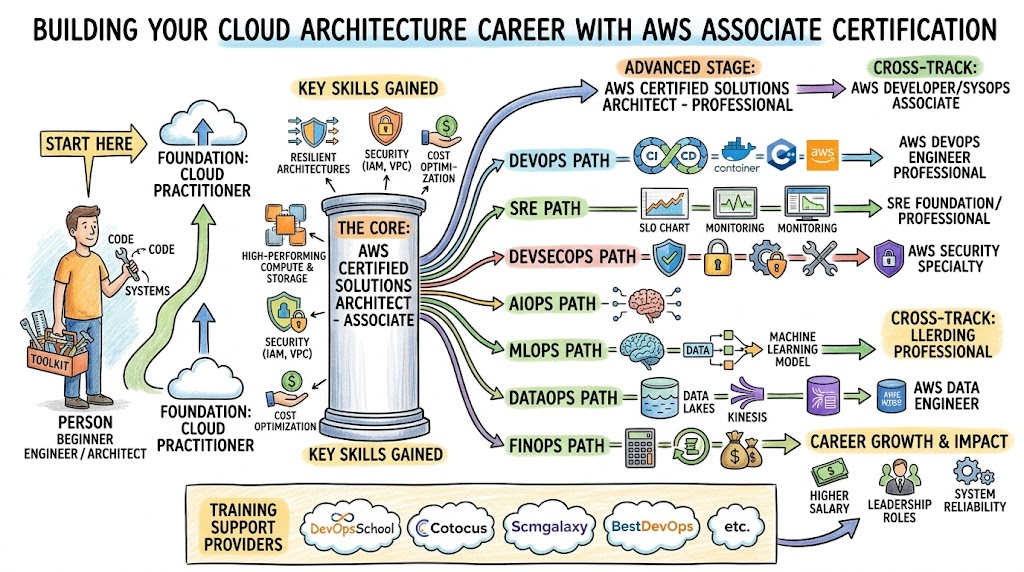
- Same-track option: AWS Certified Solutions Architect – Professional.
- Cross-track option: AWS Certified Security – Specialty.
- Leadership option: Certified Site Reliability Engineer – Foundation.
Choose Your Learning Path
1. DevOps Path
In the DevOps path, the Solutions Architect certification serves as the blueprint for building delivery pipelines. Engineers focus on how to use AWS services to facilitate continuous integration and deployment. You will learn to architect environments that support blue/green deployments and canary releases using Route 53 and ELB. This foundation allows you to build highly resilient systems where the infrastructure can be versioned and deployed just like application code.
2. DevSecOps Path
The DevSecOps path emphasizes “Security as Code” within the AWS environment. By understanding the core architecture, you can better implement automated security checks and guardrails. This track involves using AWS Config and CloudTrail to monitor for compliance and using KMS for pervasive data encryption. The Associate certification ensures you understand the underlying networking required to isolate sensitive workloads effectively from the public internet.
3. SRE Path
For those in the SRE path, the goal is to maximize system uptime and observability. You will learn to design for “High Availability” by distributing workloads across multiple Availability Zones. This track focuses on the integration of CloudWatch with Auto Scaling to handle traffic spikes without manual intervention. The certification provides the technical depth needed to analyze system bottlenecks and implement architectural changes that reduce the mean time to recovery (MTTR).
4. AIOps / MLOps Path
The AIOps and MLOps path uses AWS architecture to support massive data processing and machine learning models. You will learn how to architect high-performance compute clusters and storage solutions that can handle the IOPS required for model training. Understanding VPC endpoints and S3 security is vital here to ensure that proprietary data stays within the secure AWS backbone. This certification is the first step toward managing the infrastructure for intelligent, self-healing systems.
5. DataOps Path
The DataOps path focuses on building reliable and secure data lakes and warehouses on AWS. Professionals in this track learn to use services like AWS Glue and Athena to orchestrate data movement and analysis. By mastering the Associate level, you gain the skills to design storage layers that balance cost with access speed. It ensures that data engineers can build environments that are both accessible to analysts and strictly governed by security policies.
6. FinOps Path
In the FinOps path, the focus is on “Cost-Aware Architecture.” You will learn to use the AWS Cost Explorer and Trusted Advisor to identify optimization opportunities. This track is about making architectural trade-offs—for example, knowing when to use Spot Instances versus Reserved Instances. The Associate certification provides the necessary knowledge of AWS billing tiers and service limits to help organizations maximize their return on cloud investment.
Role → Recommended AWS Certified Solutions Architect – Associate Certifications
| Role | Recommended Certifications |
| DevOps Engineer | SAA-Associate, AWS Certified DevOps – Professional |
| SRE | SAA-Associate, Certified Site Reliability Engineer – Foundation |
| Platform Engineer | SAA-Associate, AWS Certified Developer – Associate |
| Cloud Engineer | SAA-Associate, AWS Certified SysOps – Associate |
| Security Engineer | SAA-Associate, AWS Certified Security – Specialty |
| Data Engineer | SAA-Associate, AWS Certified Data Engineer – Associate |
| FinOps Practitioner | SAA-Associate, AWS Cloud Practitioner |
| Engineering Manager | SAA-Associate, Certified Site Reliability Engineer – Foundation |
Next Certifications to Take After AWS Certified Solutions Architect – Associate
Same Track Progression
The natural progression is to move toward the AWS Certified Solutions Architect – Professional. This level challenges you to design complex, multi-account environments and handle large-scale migrations. It is the ultimate validation of a cloud architect’s ability to handle the most demanding enterprise requirements and governance models.
Cross-Track Expansion
For those looking to broaden their reach, the AWS Certified Security – Specialty is an excellent choice. Security is a top priority for every enterprise, and this certification allows you to dive deep into data protection, encryption, and incident response. It complements your architectural skills by making you a specialist in defending the cloud perimeter.
Leadership & Management Track
If you are aiming for a Director or VP of Engineering role, the Certified Site Reliability Engineer – Foundation is key. It moves the conversation from “how things work” to “how things stay reliable.” It covers the management of error budgets, post-mortems, and building a culture of shared responsibility that is essential for modern technical leadership.
Training & Certification Support Providers for AWS Certified Solutions Architect – Associate
DevOpsSchool offers an industry-aligned curriculum that focuses on practical expertise, ensuring candidates are ready for both the exam and the real-world job market.
Cotocus provides specialized mentorship for architectural design, helping professionals bridge the gap between technical theory and enterprise-level application.
Scmgalaxy acts as a massive knowledge hub, offering community-driven tutorials and the latest updates on AWS architectural patterns and DevOps tools.
BestDevOps focuses on intensive training bootcamps that help engineers quickly master the core components of the AWS cloud ecosystem.
Devsecopsschool integrates security best practices into all its cloud training, ensuring that architects are prepared to build secure-by-default systems.
Sreschool provides targeted education for engineers focused on system reliability, observability, and the operational excellence pillar of the AWS framework.
Aiopsschool teaches the next generation of architects how to implement AI and machine learning workflows onto scalable AWS infrastructure.
Dataopsschool offers deep-dives into data engineering on AWS, focusing on the architecture required for big data analytics and real-time processing.
Finopsschool helps professionals master the art of cloud cost optimization, ensuring that AWS architectures are as efficient as they are powerful.
Frequently Asked Questions (General)
1. Is the AWS Solutions Architect Associate exam difficult?
It is moderately difficult and requires a solid understanding of how different AWS services interact in a scenario.
2. How many questions are on the SAA-C03 exam?
The exam typically consists of 65 questions that must be completed within 130 minutes.
3. What is the best way to start learning AWS?
Starting with the AWS Free Tier and building small projects like a static website or a basic VPC is the best approach.
4. Do I need to be a programmer to pass this cert?
No, but you should be comfortable with technical logic and basic configuration files like JSON.
5. Can I skip the Practitioner exam and go straight to Associate?
Yes, AWS allows you to take any exam you want without needing the lower-level certifications first.
6. Does the exam include labs?
Currently, the SAA-C03 exam does not include hands-on labs, but the questions are designed to test practical knowledge.
7. How much experience is recommended before taking the exam?
AWS recommends at least one year of hands-on experience, but dedicated study can bridge that gap.
8. Is the certification recognized globally?
Yes, it is one of the most recognized and respected cloud certifications in the global IT industry.
9. Can I retake the exam if I don’t pass?
Yes, you can retake it after a 14-day waiting period, though you must pay the exam fee again.
10. What is a “scaled score”?
AWS uses a scale of 100-1000 to account for varying difficulty levels across different exam versions.
11. Are there many networking questions?
Yes, networking (VPC, Route 53, ELB) is a major component of the exam and requires careful study.
12. Does this certification expire?
Yes, it expires after three years, requiring recertification to keep your status active.
FAQs on AWS Certified Solutions Architect – Associate
1. What is the difference between S3 Standard and S3 IA?
Standard is for frequently accessed data, while IA is cheaper storage for data accessed less often but requiring rapid access.
2. When should I use an Application Load Balancer (ALB) over a Network Load Balancer (NLB)?
Use ALB for HTTP/HTTPS traffic and advanced routing; use NLB for extreme performance and TCP/UDP traffic.
3. What is the primary use of AWS IAM?
IAM is used to securely control access to AWS services and resources by creating users, groups, and roles.
4. How does Auto Scaling work with CloudWatch?
CloudWatch monitors metrics like CPU usage and triggers Auto Scaling to add or remove EC2 instances based on demand.
5. What is the benefit of using RDS over EC2 for databases?
RDS is a managed service that handles backups, patching, and high availability, reducing your operational overhead.
6. What is a VPC Peering connection?
It is a networking connection between two VPCs that allows you to route traffic between them using private IP addresses.
7. Why would an architect choose a Multi-AZ deployment?
Multi-AZ provides high availability and data redundancy by automatically replicating data to a different physical location.
8. What is the purpose of AWS CloudTrail?
CloudTrail provides a record of actions taken by a user, role, or AWS service, which is essential for security auditing.
Conclusion
The AWS Certified Solutions Architect – Associate remains the most valuable foundational step for any cloud professional. It moves you past the “how-to” of individual tools and teaches you the “system thinking” required to build at scale. In an environment where technology changes every week, the architectural principles you learn through this certification—like decoupling, automation, and defense-in-depth—will remain relevant for the rest of your career. It is an honest, rigorous validation of your skills that provides a clear return on investment through better job opportunities and the confidence to lead complex technical projects. For anyone serious about the cloud, this is the path forward.
