Introduction
Every mobile connection depends on systems that help devices identify available networks. When a phone searches for service, it needs more than a familiar carrier name. Mobile networks use technical identifiers to distinguish countries, network assignments, and service providers.
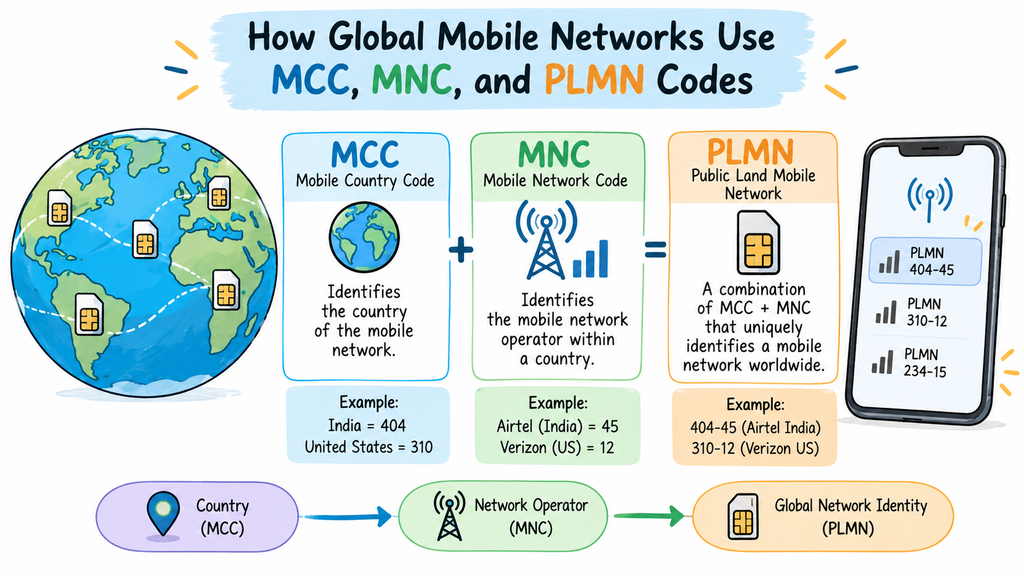
Three important terms help explain this process: Mobile Country Code (MCC), Mobile Network Code (MNC), and Public Land Mobile Network (PLMN). These identifiers play an important role in telecom databases, network research, and mobile connectivity analysis.
Although these terms often appear together, they serve different purposes. MCC identifies the country or numbering-area component, MNC identifies a network within that context, and a PLMN identifier combines the two. Understanding their relationship helps users interpret network records and avoid common identification errors.
This guide explores how these codes work, why they matter, how to look them up, and what to verify before relying on telecom data. It also explains how a structured directory such as eSIMGlobo can support mobile network research.
The Identification System Behind Mobile Connectivity
Mobile networks need consistent ways to distinguish one network assignment from another. Carrier names can vary across markets, and commercial brands do not always match the organizations that operate the underlying networks.
Structured identifiers help address this problem. They give telecom systems and researchers a standard way to refer to network assignments without relying only on brand names.
MCC and MNC work together to identify a network within the relevant numbering structure. The combined identifier commonly appears as a PLMN ID. Other information, such as an operator name or service status, provides additional context.
These fields answer different questions. An identifier can help show which network assignment a record describes, while other data must establish whether that network currently operates or supports a particular service.
Mobile Country Code: The Geographic Component
A Mobile Country Code, commonly called an MCC, contains three digits. It identifies the country or geographic numbering area associated with a mobile network assignment.
Telecom databases use MCC values to organize network records and distinguish assignments across countries and territories. Researchers can use this field to narrow a search before examining individual network codes.
However, an MCC does not identify one specific operator. Multiple mobile networks may share the same MCC because they operate within the same country or numbering area.
Common Uses of MCC Data
MCC information supports several telecom activities:
- Country-based research: Helps users organize mobile network records by their assigned geographic context.
- Operator identification: Provides the country component needed to interpret a complete network identifier.
- Roaming analysis: Helps researchers examine the geographic context of network assignments.
- Database organization: Supports consistent grouping and filtering of telecom records.
- Technical investigation: Helps engineers interpret network information reported by devices or systems.
An MCC gives researchers a useful starting point. They usually need the corresponding MNC to distinguish a particular network assignment.
Mobile Network Code: Distinguishing Network Assignments
A Mobile Network Code, or MNC, identifies a mobile network within the relevant MCC context. It works alongside the MCC to distinguish network assignments that share the same geographic component.
MNC values may contain two or three digits, depending on the applicable numbering plan. Researchers should preserve the format used by the relevant record rather than assume every MNC follows the same length.
An MNC alone may not identify a network uniquely. The same value can appear under different MCCs, so users should consider both fields together.
Why Accurate MNC Records Matter
Telecom directories often connect network codes with operator names, country details, and other information. These links help users research a network without confusing its technical identity with its commercial brand.
Correct MNC data also supports software that processes mobile network information. If a system changes a code’s format or removes a leading zero where it matters, the resulting record may no longer match the intended assignment.
Researchers should check the original format, confirm the associated MCC, and review the source before relying on an MNC record.
Public Land Mobile Network: Combining the Codes
A Public Land Mobile Network, or PLMN, refers to a public mobile telecommunications network. In network identification, a PLMN ID commonly combines an MCC and an MNC.
The MCC supplies the country or numbering-area component. The MNC supplies the network component within that context. Together, these values help distinguish a network assignment from others.
Consider this illustrative example:
| Field | Example | Meaning |
|---|---|---|
| MCC | 234 | Illustrative country or numbering-area code |
| MNC | 15 | Illustrative mobile network code |
| PLMN ID | 234-15 | Combined identifier using the example values |
These values demonstrate the relationship between the fields. They do not confirm a real operator assignment or current network status.
Different systems may display or encode PLMN identifiers in different ways. Some show the MCC and MNC with a separator, while others store them in a technical format. Always follow the format required by the system or data source.
MCC vs. MNC vs. PLMN
| Feature | MCC | MNC | PLMN ID |
|---|---|---|---|
| Full form | Mobile Country Code | Mobile Network Code | Public Land Mobile Network Identifier |
| Main purpose | Identifies the country or numbering-area component | Identifies a network within the MCC context | Combines MCC and MNC |
| Typical format | Three digits | Two or three digits | Based on the combined MCC and MNC |
| Used alone for full network identification? | No | Generally no | Provides the combined identifier |
| Important limitation | Does not identify one operator by itself | Needs the relevant MCC context | Does not prove coverage or service availability |
The three concepts form a connected identification structure. However, they do not replace other information about network operation, access, or compatibility.
How Devices and Systems Use Network Identifiers
Mobile network identification involves several technical processes. The exact details depend on the device, radio technology, network configuration, and service conditions.
At a general level, a device can detect available networks and obtain network information. Systems can then interpret the relevant identifiers to distinguish one network from another.
The device and network apply additional rules when deciding whether service can proceed. These rules may involve the user’s subscription, roaming arrangements, device capabilities, network availability, and access permissions.
This distinction is important for troubleshooting. A device may recognize a network identifier without gaining access to that network. Similarly, a database may contain a valid assignment even when a user cannot connect at a particular location.
Researchers should therefore treat network identification and service availability as separate questions.
Practical Applications of MCC, MNC, and PLMN Data
Network identifiers support different tasks across telecom research, engineering, and connectivity services. Their usefulness depends on accurate records and a clear understanding of what each field proves.
Mobile Operator Research
Telecom directories help users explore mobile operators and compare network assignments. MCC, MNC, and PLMN fields provide a structured way to search and distinguish records.
Researchers should still check the source and update status when a decision depends on a specific assignment. A directory can simplify discovery, but it cannot automatically guarantee that every record reflects current conditions.
International Roaming
Roaming allows eligible subscribers to use supported networks outside their home network’s coverage area. MCC and MNC data can help researchers identify the networks involved in a roaming arrangement.
However, matching identifiers do not prove that two operators have an active roaming agreement. Users need current provider information to confirm supported countries, networks, plans, and service conditions.
Network Testing and Troubleshooting
Engineers may inspect MCC and MNC values while testing mobile devices, applications, or network configurations. These values help them identify the network context associated with a test.
Teams should also record device details, location, test conditions, and relevant logs. This information helps them distinguish an identifier issue from a radio, subscription, or configuration problem.
Telecom Database Development
Developers can use structured network identifiers to build search tools, operator directories, and telecom reporting systems. Separate MCC and MNC fields make records easier to filter and validate.
A reliable database should preserve source values, document formatting rules, and track important updates. It should also distinguish verified assignments from incomplete or uncertain information.
eSIM Research
People researching eSIM services may want to understand which mobile networks support a particular plan. MCC, MNC, and PLMN records can help them investigate network assignments and operator relationships.
However, an eSIM provider may rely on partner networks rather than operate its own radio network. Supported networks can also vary by country, plan, device, and commercial arrangement.
Before purchasing an eSIM, check the provider’s current coverage and compatibility information. Do not treat a network code alone as proof that the service will work on your device.
How to Find and Verify Network Codes
A clear lookup process reduces confusion and helps researchers avoid incorrect conclusions. Start by deciding what you need to identify, then confirm the relevant record and its source.
Identify the Information You Have
First, determine whether you have an MCC, an MNC, a complete PLMN ID, or an operator name. This step helps you choose the right search method.
If you already have an MCC and MNC, search for the combined identifier. If you only know the commercial brand, look for a directory that connects operator records with network assignments.
Search a Structured Directory
A telecom directory can help you find records by country, operator, MCC, MNC, or PLMN. Search filters can make the process easier when a database contains many entries.
eSIMGlobo is an independent global telecom directory focused on mobile network operators and MCC, MNC, and PLMN identifiers. Researchers can use a relevant directory as a starting point when exploring network records.
Check the information provided for the specific entry. Do not assume that every directory includes every assignment or verifies every field in the same way.
Confirm the MCC and MNC Together
Check both values before identifying a network. An MNC without its MCC may lead to the wrong record, while an incorrectly formatted value may prevent a match.
Preserve leading zeros where the required format includes them. If two sources display different formats, check their documentation before deciding that the records conflict.
Verify Important Assignments
For technical work or business decisions, compare the directory entry with an appropriate authoritative assignment source. The relevant source depends on the type of record and the telecommunications framework involved.
Review any available assignment status, record date, and explanatory notes. If the source does not establish a detail, treat that detail as unconfirmed rather than filling the gap with an assumption.
Keep Research Notes
Record the source, retrieval date, identifier format, and relevant limitations. These details help another researcher understand how you reached a conclusion.
For ongoing projects, define a process for reviewing records that may change. This practice reduces the risk of outdated information moving into reports, applications, or operational systems.
How to Evaluate Telecom Directory Records
A useful telecom record should do more than display a code. It should provide enough context for users to understand what the entry represents and how much confidence they should place in it.
The following table outlines the main fields researchers may encounter.
| Data field | What it helps explain | What it does not establish by itself |
|---|---|---|
| Country or territory | Geographic context of the record | Actual coverage at a specific location |
| MCC | Country or numbering-area component | Identity of one operator by itself |
| MNC | Network code within the relevant MCC context | Current service availability |
| PLMN ID | Combined network identifier | An active roaming agreement |
| Operator name | Organization described by the record | Ownership of every associated brand |
| Commercial brand | Name customers may recognize | Ownership of the underlying network |
| Assignment or status information | Status stated by the source | Live operation unless the source confirms it |
| Source and update date | Origin and timing of the record | Complete accuracy without further checks |
These distinctions help researchers avoid mixing technical identifiers with commercial or operational details. They also help database teams decide which fields require additional verification.
Common Mistakes to Avoid
Even a simple lookup can produce misleading results when users overlook identifier formats or source limitations.
Searching by MNC Alone
An MNC value may appear in more than one MCC context. Always use the combined identifier when you need to distinguish a network assignment.
Removing Leading Zeros
Some software automatically removes leading zeros when it treats identifiers as numbers. Store codes in a suitable text or structured format when necessary to preserve the original value.
Assuming a Code Proves Coverage
A network assignment does not guarantee service in every area. Check current coverage information, device compatibility, subscription conditions, and other relevant requirements.
Confusing a Brand With a Network Operator
A commercial brand may sell mobile services through another operator’s network. Research the relationship before concluding that the brand owns or operates the underlying network.
Ignoring Record Dates
An older entry may not reflect the latest assignment information. Check the record’s source and date, then verify important details before using them.
Treating Every Format as Identical
Databases may display or encode MCC, MNC, and PLMN values differently. Confirm the format rules before comparing records or importing them into another system.
Data Quality and Responsible Use
Accurate network research depends on good data management. Teams should maintain consistent fields, track sources, and review records according to their needs.
Keep MCC and MNC values separate when the database design allows it. This approach supports easier validation and helps applications build a combined PLMN identifier without losing the original values.
When sources disagree, investigate the difference rather than selecting a value without explanation. Check the relevant authority, record date, numbering context, and formatting rules.
Privacy also matters. MCC and MNC are network identifiers, not personal subscriber identifiers. However, systems that collect network information may also contain device logs, location details, account data, or other sensitive information. Apply suitable access controls and retention rules to those associated records.
How eSIMGlobo Supports Network Research
Researchers often need to examine mobile network information from different countries and distinguish technical identifiers from operator details. A structured directory can provide a convenient starting point for that work.
eSIMGlobo focuses on researching mobile network operators and MCC, MNC, and PLMN identifiers. Its subject area makes it relevant to people exploring network assignments, comparing records, or investigating telecom terminology.
Users should review the details available for each record and verify important claims through appropriate authoritative sources. This is especially important when research informs software development, connectivity decisions, or business operations.
For eSIM and roaming research, combine identifier lookups with current provider documentation. That extra check helps establish whether a particular plan or service actually supports the network in question.
Frequently Asked Questions
1. What is the main purpose of an MCC?
An MCC identifies the country or numbering-area component associated with a mobile network assignment. It helps telecom systems organize network records by geographic context.
2. How does an MNC differ from an MCC?
An MCC provides the country or numbering-area component, while an MNC identifies a network within that context. Researchers generally need both values to identify a network assignment accurately.
3. What information does a PLMN ID contain?
A PLMN ID commonly combines the MCC and MNC. Together, these values provide a structured identifier for a public mobile network assignment.
4. Can two networks use the same MNC?
The same MNC value can appear under different MCCs. Therefore, researchers should interpret the MNC together with its associated MCC instead of treating it as a globally unique code.
5. Why do some MNC values have two digits and others have three?
The format depends on the applicable numbering plan. Researchers should follow the format specified by the relevant assignment record and preserve leading zeros where required.
6. Does a PLMN ID confirm that a network is active?
No. A PLMN ID identifies a network assignment, but it does not independently prove current operation or service availability. Users need appropriate current evidence for those claims.
7. How can MCC and MNC data help with roaming research?
The identifiers can help researchers distinguish the networks involved in a roaming arrangement. However, they do not prove that a roaming agreement exists or that a particular subscriber can access the network.
8. What should I do if two directories show different codes?
Check each source’s authority, update date, identifier format, and record context. If the difference remains unclear, consult an appropriate authoritative assignment source before relying on either entry.
9. How do these identifiers relate to eSIM compatibility?
They can help researchers investigate the mobile networks associated with an eSIM service. Actual compatibility also depends on the device, plan, supported networks, and provider arrangements.
10. Where can I research MCC, MNC, and PLMN records?
A structured telecom directory such as eSIMGlobo can help users explore mobile network operator information and network identifiers. Verify important records with suitable authoritative sources before using them for critical decisions.
Conclusion
MCC, MNC, and PLMN identifiers provide a structured way to distinguish mobile network assignments. Each term has a specific role, and researchers get the clearest results when they understand how the three relate.
These identifiers support operator research, network testing, roaming analysis, and telecom database development. Still, they do not independently prove coverage, active service, or device compatibility.
Start with a reliable directory, check the full identifier, and preserve its required format. For important decisions, verify the record and its context before drawing conclusions. This approach makes telecom research more accurate, useful, and dependable.
