Introduction
The Google Cloud Professional Cloud DevOps Engineer is a premier certification designed for individuals who bridge the gap between software development and IT operations. In an era where cloud-native ecosystems dominate, this credential validates your ability to balance service reliability with delivery speed. This guide is crafted for engineers and managers looking to master the intricacies of the Google Cloud ecosystem while adopting Site Reliability Engineering principles.
At DevOpsSchool, the focus remains on equipping professionals with the practical skills needed to manage production-grade environments. Whether you are transitioning from traditional operations or looking to specialize in platform engineering, this roadmap provides the clarity required to navigate your career. By the end of this guide, you will understand how this certification integrates into broader industry trends like AIOps, FinOps, and DevSecOps.
What is the Google Cloud Professional Cloud DevOps Engineer?
The Google Cloud Professional Cloud DevOps Engineer certification represents a deep understanding of the intersection between Google Cloud technologies and Site Reliability Engineering (SRE) methodologies. It is not merely a test of tool knowledge but a validation of a professional’s ability to implement culture and processes that ensure high availability. This certification exists to standardize how organizations build, deploy, and monitor services in a distributed environment.
Unlike entry-level certifications, this program emphasizes real-world, production-focused learning over abstract theory. It covers the entire lifecycle of a service, from continuous integration and delivery to incident management and post-mortem analysis. For enterprise practitioners, it serves as a benchmark for implementing modern engineering workflows that align with the technical rigors of high-scale cloud environments.
Who Should Pursue Google Cloud Professional Cloud DevOps Engineer?
This certification is highly beneficial for Site Reliability Engineers (SREs), DevOps engineers, and cloud architects who are responsible for the stability and scalability of cloud services. Beginners with a strong foundation in Linux and networking can use this as a target to move into specialized roles. Meanwhile, experienced engineers will find value in formalizing their knowledge of Google-specific tools like GKE, Cloud Build, and the Operations Suite.
Managers and technical leaders also benefit from pursuing this path to better understand the technical constraints and capabilities of their teams. From a global perspective, including the rapidly growing tech hubs in India, the demand for certified Google Cloud professionals is at an all-time high. It provides a common language for teams working across borders, ensuring that security and reliability are baked into the infrastructure from day one.
Why Google Cloud Professional Cloud DevOps Engineer is Valuable Today and Beyond
The value of this certification lies in the massive enterprise adoption of Google Cloud Platform (GCP) for its data analytics and Kubernetes leadership. Organizations are moving away from monolithic architectures toward microservices, and they require engineers who can manage these complex systems effectively. Holding this certification ensures that your skills remain relevant even as specific tools evolve, because it focuses on the underlying principles of automation and observability.
Investing time in this program offers a significant return on career investment, as it signals to employers that you can handle high-stakes production environments. As companies prioritize “Day 2” operations—focusing on maintaining what they have built—the role of the DevOps engineer becomes indispensable. This certification is a long-term asset that provides longevity in a volatile market by anchoring your expertise in both specialized tooling and universal engineering best practices.
Google Cloud Professional Cloud DevOps Engineer Certification Overview
The Google Cloud Professional Cloud DevOps Engineer certification program is delivered via the comprehensive training modules available at DevOpsSchool and hosted on the main site devopsschool.com. This program is structured to provide a logical progression from foundational concepts to advanced architectural strategies. The assessment approach is heavily focused on scenario-based questions that mirror the challenges faced by engineers in actual production environments.
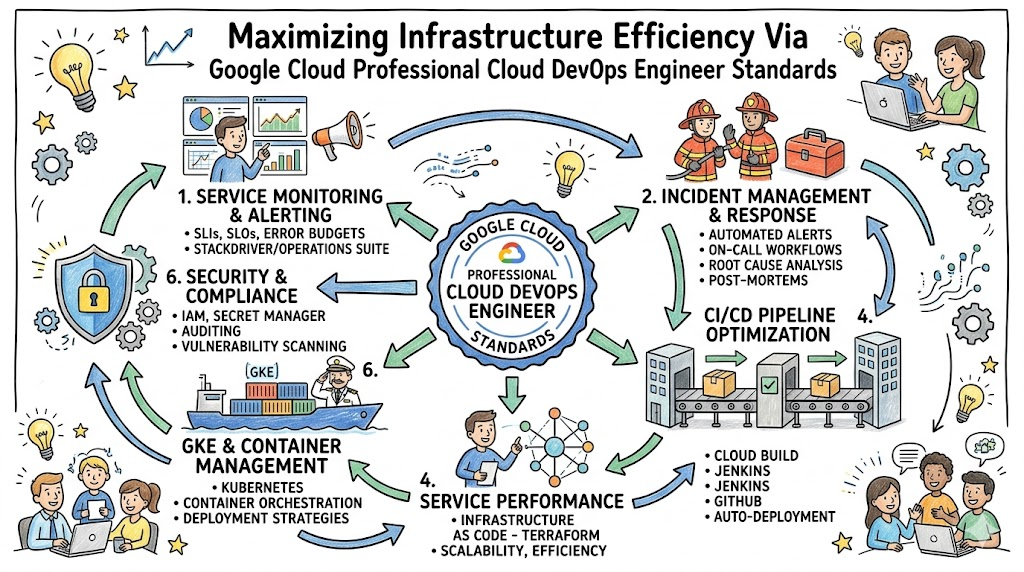
The ownership of this learning path is centered on developing a mindset of continuous improvement and automation. It is structured to cover five main pillars: booting and managing cloud-native services, implementing CI/CD pipelines, optimizing service performance, managing incidents, and automating infrastructure. This practical structure ensures that a certified professional can walk into any GCP-based environment and immediately contribute to the organization’s technical maturity.
Google Cloud Professional Cloud DevOps Engineer Certification Tracks & Levels
The certification ecosystem begins with foundational tracks that introduce the basic constructs of Google Cloud, such as projects, IAM, and the resource hierarchy. As candidates move to the professional level, the focus shifts toward specialization in DevOps and SRE. These levels are designed to align with career progression, moving from individual contributors to senior architects who oversee complex cross-functional platforms.
Advanced tracks often involve deep dives into specialized areas like FinOps for cost optimization or DevSecOps for integrated security. Each level builds upon the previous one, ensuring that there are no gaps in the engineer’s understanding of the cloud lifecycle. By following this progression, professionals can transition from being generalists to becoming subject matter experts who can lead large-scale digital transformation initiatives.
Complete Google Cloud Professional Cloud DevOps Engineer Certification Table
| Track | Level | Who it’s for | Prerequisites | Skills Covered | Recommended Order |
| Cloud Infrastructure | Foundational | Aspiring Cloud Engineers | Basic IT knowledge | Cloud basics, IAM, Compute | 1 |
| Cloud Engineering | Associate | Junior DevOps Engineers | 6 months+ GCP exp | GKE, Networking, Storage | 2 |
| DevOps & SRE | Professional | Senior DevOps/SREs | 3+ years industry exp | CI/CD, Monitoring, SRE | 3 |
| Cloud Architecture | Professional | Solutions Architects | 3+ years design exp | Design, Migration, Security | 4 |
| Security Engineering | Professional | Security Specialists | 3+ years security exp | IAM, Encryption, Compliance | 5 |
Detailed Guide for Each Google Cloud Professional Cloud DevOps Engineer Certification
Google Cloud Professional Cloud DevOps Engineer – Associate Level
What it is
This level validates the ability to deploy applications, monitor operations, and manage enterprise solutions on Google Cloud. It acts as the stepping stone for those entering the cloud ecosystem.
Who should take it
It is suitable for junior cloud engineers or system administrators who want to transition into a cloud-focused role. It requires a fundamental understanding of command-line tools and web consoles.
Skills you’ll gain
- Setting up a cloud solution environment.
- Deploying and implementing a cloud solution.
- Configuring access and security.
- Ensuring successful operation of a cloud solution.
Real-world projects you should be able to do
- Setting up a multi-region VPC with firewall rules.
- Deploying a containerized application on Google Kubernetes Engine.
- Configuring automated backups for Cloud SQL instances.
Preparation plan
- 7-14 Days: Review the official exam guide and get familiar with the GCP console interface.
- 30 Days: Complete hands-on labs focusing on GKE and networking.
- 60 Days: Take practice exams and refine knowledge of CLI commands (gsutil, gcloud).
Common mistakes
- Neglecting to study the gcloud command-line syntax.
- Underestimating the importance of IAM roles and permissions.
Best next certification after this
- Same-track option: Professional Cloud DevOps Engineer.
- Cross-track option: Professional Cloud Architect.
- Leadership option: Engineering Management Foundational.
Google Cloud Professional Cloud DevOps Engineer – Professional Level
What it is
This is the core certification that validates an engineer’s ability to apply SRE principles to Google Cloud. It focuses on building high-velocity, reliable software delivery pipelines.
Who should take it
Senior DevOps engineers, SREs, and Platform engineers with at least three years of industry experience and one year of GCP experience should take this.
Skills you’ll gain
- Applying site reliability engineering principles to a service.
- Implementing CI/CD pipelines using Cloud Build and Jenkins.
- Monitoring and logging with Google Cloud Operations Suite.
- Managing incidents and post-mortem processes.
Real-world projects you should be able to do
- Building a blue-green deployment pipeline for a microservices app.
- Setting up SLIs, SLOs, and error budgets for a production service.
- Automating infrastructure provisioning using Terraform and Cloud Foundation Toolkit.
Preparation plan
- 7-14 Days: Read the SRE Book by Google and understand the core philosophy.
- 30 Days: Work extensively with Cloud Logging, Cloud Monitoring, and Cloud Trace.
- 60 Days: Design a complete end-to-end CI/CD pipeline and practice disaster recovery scenarios.
Common mistakes
- Focusing only on the tools and ignoring the SRE culture/philosophy questions.
- Not understanding the specific nuances of Stackdriver (Operations Suite) alerting.
Best next certification after this
- Same-track option: Professional Security Engineer.
- Cross-track option: Professional Data Engineer.
- Leadership option: Certified SRE Leader.
Choose Your Learning Path
DevOps Path
The DevOps path focuses on the automation of software delivery and infrastructure changes. It emphasizes the “Shift Left” mentality where security and testing are integrated early in the development cycle. Engineers on this path will master Jenkins, Cloud Build, and Artifact Registry to create seamless deployment workflows.
DevSecOps Path
In this path, the priority is integrating security into every layer of the DevOps lifecycle. You will learn how to automate vulnerability scanning, manage secrets using Secret Manager, and implement Binary Authorization on GKE. This ensures that only verified and secure code makes it into your production environment.
SRE Path
The Site Reliability Engineering path is for those who treat operations as a software problem. You will focus on service health, latency, and performance using SLIs and SLOs. This path emphasizes the reduction of toil through automation and the creation of robust incident response frameworks.
AIOps Path
This specialized path explores the use of machine learning to enhance IT operations. You will learn to use Google Cloud’s AI tools to predict outages and automate root cause analysis. This is essential for managing the massive amounts of telemetry data generated by modern microservices.
MLOps Path
The MLOps path is designed for engineers who need to deploy and monitor machine learning models at scale. It covers the automation of ML pipelines using Vertex AI and Kubeflow. You will focus on model versioning, data lineage, and ensuring that ML models perform reliably in production.
DataOps Path
DataOps focuses on the automated, policy-driven management of data to improve quality and reduce cycle time. You will work with BigQuery, Dataflow, and Pub/Sub to build resilient data pipelines. This path ensures that data is available and accurate for downstream analytics and applications.
FinOps Path
The FinOps path is dedicated to cloud financial management and cost optimization. You will learn how to use BigQuery billing exports and Looker to visualize cloud spend and identify waste. This path bridges the gap between engineering teams and finance departments to maximize business value.
Role → Recommended Google Cloud Professional Cloud DevOps Engineer Certifications
| Role | Recommended Certifications |
| DevOps Engineer | Associate Cloud Engineer, Professional Cloud DevOps Engineer |
| SRE | Professional Cloud DevOps Engineer, Professional Cloud Architect |
| Platform Engineer | Professional Cloud DevOps Engineer, Professional Security Engineer |
| Cloud Engineer | Associate Cloud Engineer, Professional Cloud Network Engineer |
| Security Engineer | Professional Security Engineer, Professional Cloud DevOps Engineer |
| Data Engineer | Professional Data Engineer, Associate Cloud Engineer |
| FinOps Practitioner | Professional Cloud Architect, Cloud Digital Leader |
| Engineering Manager | Cloud Digital Leader, Professional Cloud DevOps Engineer |
Next Certifications to Take After Google Cloud Professional Cloud DevOps Engineer
Same Track Progression
Once you have mastered the DevOps engineer certification, the logical next step is to deepen your expertise in specific Google Cloud infrastructure areas. This could include the Professional Cloud Network Engineer certification to master complex hybrid-cloud connectivity. Alternatively, focusing on the Professional Security Engineer certification allows you to become the primary authority on safeguarding cloud-native assets.
Cross-Track Expansion
Broadening your skill set into the data domain is a powerful way to increase your professional value. Pursuing the Professional Data Engineer certification will help you understand the operational requirements of Big Data and AI workloads. You can also explore the Professional Cloud Architect path to take a more holistic view of system design and business requirements across the entire organization.
Leadership & Management Track
For those looking to move into management, certifications like the Cloud Digital Leader provide a high-level overview of cloud business value. Transitioning into leadership involves moving away from the “how” of technical implementation to the “why” of strategic technology adoption. This track prepares you to lead engineering teams and communicate technical risks and opportunities to executive stakeholders.
Training & Certification Support Providers for Google Cloud Professional Cloud DevOps Engineer
- DevOpsSchool
As a leading training provider, this organization offers an immersive learning experience tailored for working professionals. They focus on hands-on labs and real-world project scenarios that go beyond the exam syllabus. Their curriculum is updated frequently to reflect the latest changes in the Google Cloud ecosystem, ensuring that students are prepared for both the certification and the demands of the job market. - Cotocus
This provider is known for its specialized consulting and training approach, focusing on enterprise-grade cloud transformations. They provide in-depth sessions on Kubernetes and infrastructure as code, which are critical components of the Google Cloud DevOps track. Their instructors are often industry practitioners who bring a wealth of production-grade experience to the classroom, helping students understand complex architectural patterns. - Scmgalaxy
With a strong community focus, this provider offers extensive resources on configuration management and continuous integration tools. They emphasize the integration of open-source tools within the Google Cloud environment, such as using Terraform for GCP or managing GitLab runners on GKE. Their documentation and community forums are excellent resources for engineers looking to troubleshoot specific technical challenges in a DevOps context. - BestDevOps
This training platform specializes in high-velocity delivery methodologies and SRE practices. They offer targeted bootcamps that are designed to take an engineer from zero to certified in a structured, time-bound manner. Their training modules are highly interactive, focusing on the practical application of SLIs, SLOs, and incident management protocols within the Google Cloud Operations Suite. - devsecopsschool.com
As the name suggests, this provider focuses exclusively on the intersection of security and DevOps. They offer specialized training on securing GCP environments, including identity management and network security. Their courses are essential for professionals who want to master the “Sec” part of DevSecOps, providing the skills needed to build automated security gates into the CI/CD pipeline. - sreschool.com
This platform is dedicated to the discipline of Site Reliability Engineering. They provide the most comprehensive deep dives into Google’s SRE philosophy and how it can be implemented using GCP tools. Students learn how to manage error budgets, conduct blameless post-mortems, and build observability frameworks that ensure long-term service stability and performance in large-scale systems. - aiopsschool.com
Focusing on the future of operations, this provider helps engineers integrate artificial intelligence into their DevOps workflows. They cover the use of Google Cloud’s machine learning APIs to monitor system health and predict potential failures. Their training is crucial for engineers looking to stay ahead of the curve by adopting intelligent automation and predictive maintenance strategies. - dataopsschool.com
This provider specializes in the operational aspects of data engineering. They offer training on how to apply DevOps principles to data pipelines, ensuring that data is delivered reliably and at high speed. Their curriculum covers tools like BigQuery and Dataflow, focusing on how to automate the testing and deployment of data-centric applications on Google Cloud. - finopsschool.com
This platform addresses the growing need for cloud cost management. They provide training on the FinOps framework and how to apply it within the Google Cloud environment to ensure cost-transparency. Their courses are designed for both engineers and finance professionals who want to optimize cloud spending and ensure that every dollar spent on GCP delivers maximum business value.
Frequently Asked Questions
- How difficult is the Google Cloud Professional Cloud DevOps Engineer exam?
The exam is considered one of the more challenging certifications because it requires a mix of deep technical knowledge and a solid grasp of SRE philosophy. - What is the typical time required to prepare for this certification?
Most professionals with prior cloud experience spend between 30 to 60 days of focused study to feel confident for the exam. - Are there any formal prerequisites for the professional level?There are no mandatory prerequisites, but Google recommends having at least three years of industry experience and one year of GCP experience.
- What is the return on investment for this certification?Certified professionals often see a significant increase in salary and job opportunities, as GCP DevOps experts are in high demand globally.
- In what sequence should I take the Google Cloud certifications?
It is generally recommended to start with the Associate Cloud Engineer before moving to the Professional Cloud DevOps Engineer or Architect levels. - Does this certification cover multi-cloud strategies?While the exam focuses on Google Cloud tools, the SRE and DevOps principles you learn are highly applicable to any cloud or hybrid environment.
- How long is the certification valid for?
Google Cloud professional certifications are typically valid for two years, after which you must recertify to maintain your status. - Is hands-on experience mandatory to pass the exam?
Yes, because the exam is scenario-based, it is very difficult to pass without having spent time actually working in the Google Cloud console and CLI. - How does this certification differ from the Professional Cloud Architect?
The Architect exam focuses on high-level design and business requirements, while the DevOps exam focuses on the delivery, reliability, and operations of those designs. - What is the format of the exam?
The exam consists of multiple-choice and multiple-select questions and is typically two hours long, proctored either online or at a testing center. - Are there lab-based questions in the actual exam?
The current format uses scenario-based multiple-choice questions rather than live labs, but these questions require practical knowledge to answer correctly. - Can this certification help me move into a management role?Yes, it provides the technical authority and understanding of modern processes that are essential for leading successful engineering teams.
FAQs on Google Cloud Professional Cloud DevOps Engineer
- What specific SRE concepts are most important for this exam?
Candidates must have a deep understanding of Service Level Indicators (SLIs), Service Level Objectives (SLOs), error budgets, toil reduction, and the incident management lifecycle. - Which Google Cloud tools are emphasized the most in the DevOps track?
The primary tools include Google Kubernetes Engine (GKE), Cloud Build, Artifact Registry, Cloud Monitoring, Cloud Logging, and Deployment Manager or Terraform. - How does the exam test incident management skills?
You will be presented with scenarios involving service outages and asked to identify the best way to diagnose, mitigate, and conduct a post-mortem for the incident. - Is knowledge of Kubernetes a major part of the certification?Yes, Kubernetes is central to the Google Cloud DevOps ecosystem, so you must understand how to deploy, scale, and monitor applications on GKE.
- How much weight is given to CI/CD pipelines in the assessment?
A significant portion of the exam focuses on building, testing, and deploying code safely and frequently using automated pipelines and various deployment strategies. - Do I need to be a developer to pass this exam?
While you don’t need to be a full-time developer, you should be comfortable with scripts, YAML configurations, and the general software development lifecycle. - How does this certification address security within the DevOps process?
The exam covers “shifting left” on security, including managing secrets, identity and access management (IAM), and securing the container supply chain. - Are cost optimization and FinOps included in the DevOps exam?
Yes, engineers are expected to understand how to monitor resource usage and implement cost-effective architectures without sacrificing service reliability.
Final Thoughts: Is Google Cloud Professional Cloud DevOps Engineer Worth It?
From the perspective of a senior engineer who has seen the industry shift from manual rack-and-stack to fully automated cloud environments, the answer is a resounding yes. This certification is more than a badge; it is a rigorous training ground that forces you to think about software at scale. It moves you away from the mindset of just “keeping the lights on” toward a more proactive, engineering-led approach to operations.
The industry is no longer looking for people who can just click buttons in a console. They want professionals who understand the trade-offs between speed and stability. By mastering the Google Cloud Professional Cloud DevOps Engineer curriculum, you are proving that you can handle the complexity of modern systems while maintaining the high standards of reliability that today’s businesses demand. It is a solid investment in your professional future.
