Introduction
Organizations today are expected to deliver software rapidly without compromising quality, security, or reliability. Customers expect frequent feature updates, minimal downtime, and seamless digital experiences. Meeting these expectations requires more than adopting modern tools—it demands proven engineering practices that scale with business growth.
Many organizations invest in cloud platforms, CI/CD pipelines, Kubernetes clusters, and automation frameworks but still struggle with slow deployments, recurring production incidents, security vulnerabilities, and operational inefficiencies. The difference often lies in how these technologies are implemented rather than which technologies are selected.
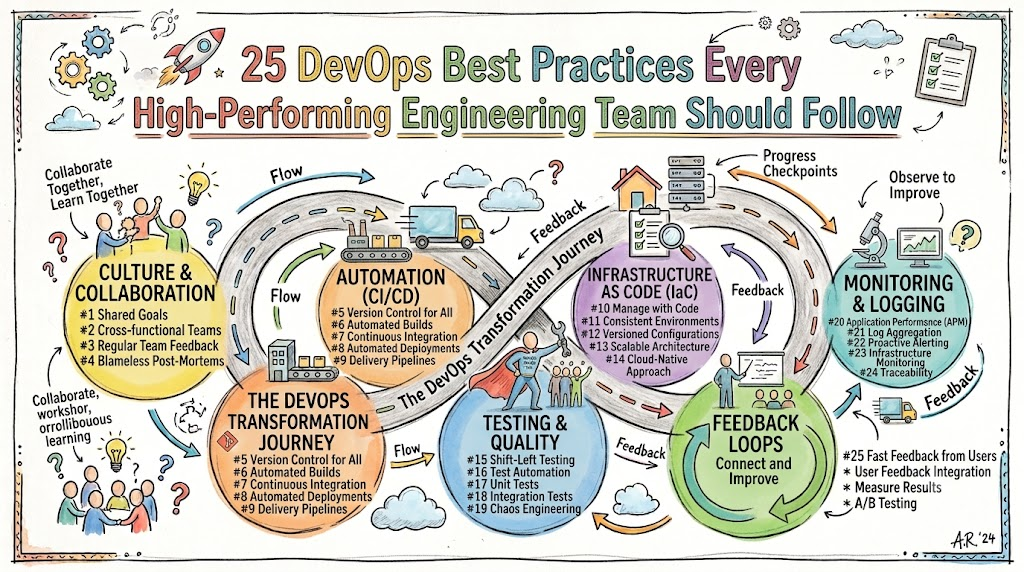
This guide explores 25 practical DevOps best practices that help engineering teams improve collaboration, automate delivery pipelines, strengthen security, and build reliable cloud-native applications.
Why Best Practices Matter
Technology evolves rapidly, but engineering principles remain consistent. High-performing organizations succeed because they establish repeatable processes that reduce human error, improve collaboration, and enable continuous improvement.
Benefits of following DevOps best practices include:
- Faster release cycles
- Improved software quality
- Better infrastructure consistency
- Reduced operational costs
- Stronger application security
- Greater system reliability
- Improved developer productivity
- Easier compliance and auditing
1. Build a Collaborative Engineering Culture
DevOps begins with people rather than tools.
Development, operations, QA, security, and business teams should share responsibility for delivering reliable software. Regular communication, shared objectives, and transparent workflows reduce delays and improve decision-making.
2. Store Everything in Version Control
Source code is only one part of a modern application.
Organizations should also version:
- Infrastructure definitions
- Kubernetes manifests
- Pipeline configurations
- Automation scripts
- Documentation
- Configuration files
Version control improves traceability and simplifies collaboration.
3. Automate Software Builds
Manual builds create inconsistency and increase deployment risks.
Automated build systems validate every code change, generate application artifacts, and provide rapid feedback to developers.
4. Keep Continuous Integration Fast
Lengthy build pipelines slow development.
High-performing teams optimize pipelines by:
- Running tests in parallel
- Caching dependencies
- Eliminating redundant tasks
- Executing incremental builds
Quick feedback encourages frequent code integration.
5. Automate Software Testing
Testing should occur throughout the development lifecycle.
A balanced testing strategy includes:
- Unit tests
- Integration tests
- API tests
- UI automation
- Performance testing
- Security testing
Automation increases release confidence while reducing manual effort.
6. Treat Infrastructure Like Software
Infrastructure as Code enables consistent environments across development, testing, and production.
Every infrastructure change should undergo:
- Code review
- Version control
- Automated validation
- Deployment through pipelines
7. Standardize Development Environments
Inconsistent environments lead to deployment failures.
Containerization and automation help ensure developers, testers, and operations teams work with identical application environments.
8. Adopt Containers Strategically
Containers simplify application packaging and deployment.
However, organizations should avoid containerizing every workload without understanding operational requirements.
A phased adoption strategy generally produces better long-term results.
9. Implement Kubernetes Governance
Kubernetes requires governance to remain manageable.
Important governance areas include:
- Namespace strategy
- Resource quotas
- Access control
- Network policies
- Backup planning
- Cluster upgrades
Strong governance reduces operational complexity.
10. Integrate Security from the Beginning
Security should become part of software delivery rather than an isolated review process.
Automated security validation helps identify vulnerabilities early while maintaining deployment speed.
11. Secure Secrets Properly
Application credentials should never be stored inside source code repositories.
Organizations should use centralized secret management solutions with appropriate access controls and audit capabilities.
12. Build Reliable CI/CD Pipelines
A mature delivery pipeline should include:
- Build validation
- Automated testing
- Security scanning
- Artifact management
- Deployment approvals
- Rollback mechanisms
Reliability is more important than deployment frequency alone.
13. Monitor Business Metrics Alongside Technical Metrics
Monitoring CPU utilization is useful, but customer-focused metrics provide greater business value.
Examples include:
- Login success rate
- Checkout completion
- API response times
- Payment success percentage
- User satisfaction indicators
14. Invest in Observability
Observability combines metrics, logs, traces, and dashboards to provide complete visibility into application behavior.
Well-designed observability reduces troubleshooting time and improves incident response.
15. Practice Site Reliability Engineering
Reliability should be measured rather than assumed.
Engineering teams should define:
- Availability targets
- Error budgets
- Incident response procedures
- Recovery objectives
This creates predictable operational performance.
16. Minimize Manual Deployments
Manual production releases increase operational risk.
Deployment automation ensures consistent execution while reducing configuration mistakes.
17. Review Every Production Incident
Incidents should become learning opportunities rather than blame sessions.
Post-incident reviews help identify:
- Root causes
- Process improvements
- Automation opportunities
- Knowledge gaps
Continuous learning strengthens engineering maturity.
18. Optimize Cloud Spending
Cloud resources should be monitored continuously.
Common optimization activities include:
- Removing idle resources
- Rightsizing virtual machines
- Storage lifecycle management
- Reserved capacity planning
Cloud efficiency contributes directly to business profitability.
19. Build Internal Engineering Standards
Documented engineering standards improve consistency across teams.
Standards may include:
- Branch naming
- Pipeline templates
- Infrastructure modules
- Logging conventions
- Monitoring requirements
Standardization simplifies scaling.
20. Encourage Continuous Learning
Technology evolves rapidly.
Organizations should regularly invest in:
- Technical workshops
- Certification preparation
- Hands-on laboratories
- Internal knowledge-sharing sessions
Learning directly influences engineering quality.
21. Use GitOps for Kubernetes Deployments
GitOps simplifies Kubernetes operations by using Git repositories as the single source of truth for infrastructure and application configurations.
Benefits include:
- Easier rollback
- Improved auditability
- Consistent deployments
- Reduced manual intervention
22. Build Self-Service Developer Platforms
Platform Engineering enables developers to provision environments, deploy applications, and access shared services without waiting for manual operational support.
This reduces bottlenecks while improving developer productivity.
23. Continuously Measure DevOps Performance
Organizations should evaluate:
- Deployment frequency
- Lead time
- Recovery time
- Change failure rate
- Infrastructure utilization
- Customer experience
Measurement drives continuous improvement.
24. Train Teams Before Expanding Technology
Successful technology adoption depends on people.
Before implementing advanced cloud-native platforms, organizations should ensure engineering teams possess the necessary skills through structured training and mentoring.
25. Work with Experienced DevOps Professionals
External expertise often accelerates transformation.
Experienced DevOps trainers and consultants help organizations:
- Design scalable architectures
- Improve automation
- Build Kubernetes platforms
- Strengthen DevSecOps
- Introduce SRE practices
- Upskill engineering teams
Professional guidance reduces implementation risks while accelerating business outcomes.
Common Challenges During DevOps Adoption
Organizations frequently encounter:
- Resistance to cultural change
- Legacy infrastructure constraints
- Limited automation
- Skill shortages
- Security concerns
- Cloud cost management
- Operational complexity
Addressing these challenges requires both technical improvements and organizational commitment.
Building a Long-Term DevOps Strategy
Sustainable DevOps success requires balancing technology, people, and processes.
An effective strategy typically includes:
- Current-state assessment
- Automation roadmap
- Infrastructure modernization
- Security integration
- Continuous measurement
- Ongoing training
- Incremental improvement
Organizations that adopt this structured approach are better positioned for long-term success.
Conclusion
DevOps excellence is achieved through consistent engineering practices rather than individual technologies. By focusing on collaboration, automation, security, observability, and continuous learning, organizations can build resilient software delivery systems that support innovation and business growth.
Whether an organization is beginning its DevOps journey or expanding an existing cloud-native platform, applying these best practices creates a strong foundation for sustainable engineering success.
Frequently Asked Questions
What are DevOps best practices?
They are proven engineering methods that improve collaboration, automation, software quality, security, and operational reliability throughout the software development lifecycle.
Why is Infrastructure as Code important?
Infrastructure as Code ensures consistent, repeatable, and version-controlled infrastructure provisioning, reducing manual errors and improving deployment reliability.
How does GitOps improve Kubernetes management?
GitOps uses Git repositories as the authoritative source for infrastructure and deployment configurations, simplifying automation, auditing, and rollback.
Why should organizations invest in DevOps training?
Training helps engineering teams develop practical skills needed to implement modern automation, cloud, Kubernetes, security, and reliability practices effectively.
Can small companies benefit from DevOps best practices?
Yes. Organizations of every size can improve delivery speed, software quality, operational efficiency, and collaboration by adopting DevOps principles.
